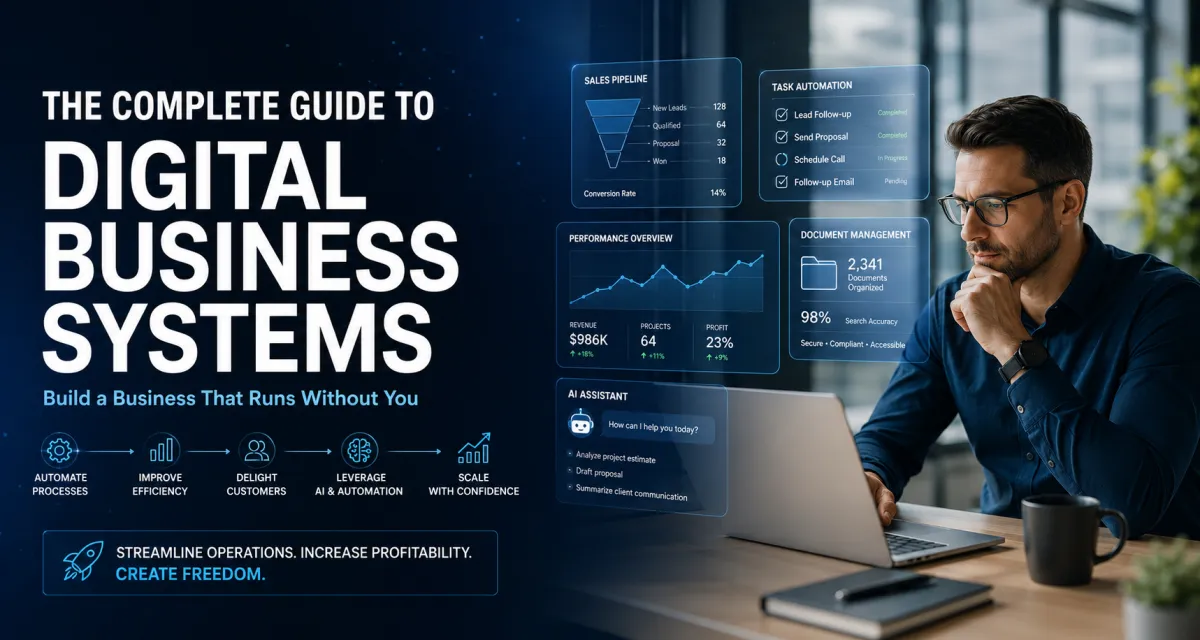
The Complete Guide to Digital Business Systems: Build a Business That Runs Without You
Estimated Reading Time
⏱ 20–25 Minute Read
Table of Contents:
The Complete Guide to Digital Business Systems: Build a Business That Runs Without You
The Complete Guide to Digital Business Systems: Build a Business That Runs Without You
The Complete Guide to Digital Business Systems
Build a Business That Runs Without You
What Are Digital Business Systems?
Why Every Business Needs Systems
The Hidden Cost of Manual Processes
The Core Digital Business Systems Every Company Should Have
Customer Relationship Management (CRM)
Operations & Workflow Management
Artificial Intelligence & Business Automation: How AI Is Changing the Way Companies Operate
AI Is Most Powerful When Systems Work Together
Building Standard Operating Procedures (SOPs): The Foundation of Every Scalable Business
Every Business Already Has SOPs
Build Checklists Before Automation
Review and Improve Your Systems
Build a Business That Doesn't Depend on You
Choosing the Right Business Software
Common Mistakes Businesses Make
Buying Software Without a Plan
Expecting Immediate Perfection
Your Digital Transformation Roadmap
Step 1 — Document Your Current Processes
Step 3 — Build Standard Operating Procedures
Step 4 — Implement Digital Systems
Step 5 — Introduce Artificial Intelligence
What is a digital business system?
Do small businesses really need business systems?
Is artificial intelligence replacing employees?
How long does digital transformation take?
Is expensive software always better?
Ready to Build a Smarter Business?
The Complete Guide to Digital Business Systems
Build a Business That Runs Without You
Running a successful business shouldn't mean working longer hours, constantly putting out fires, or becoming the bottleneck for every decision. The most successful companies don't simply work harder—they build systems that allow their businesses to operate efficiently, consistently, and profitably.
In this guide, you'll learn how digital business systems can transform the way your company operates, reduce repetitive work, improve customer experiences, and position your business for long-term growth through automation and artificial intelligence.
Introduction
Every business starts with an idea. In the early days, it's normal for the owner to wear every hat—answering phones, meeting customers, creating estimates, managing employees, sending invoices, posting on social media, and solving problems as they arise. While this approach may work in the beginning, it eventually becomes the biggest obstacle to growth.
As a business grows, complexity grows with it. More customers mean more communication. More employees require better training and accountability. More projects create additional paperwork, scheduling challenges, and administrative tasks. Without documented systems, every new customer or employee increases the workload rather than improving efficiency.
This is where digital business systems become essential.
A digital business system is more than software. It's a structured, repeatable process supported by technology that allows your business to operate consistently, efficiently, and with less dependence on any single individual. Instead of relying on memory or handwritten notes, digital systems create standardized workflows that ensure work gets done the same way every time.
Imagine a business where customer inquiries are automatically tracked, estimates are generated in minutes instead of hours, marketing campaigns run on schedule, documents are organized automatically, and employees know exactly what to do because every process has been documented. This isn't reserved for large corporations anymore. Modern software and artificial intelligence have made these capabilities accessible to businesses of every size.
Digital business systems also provide something every entrepreneur eventually wants: freedom. Rather than spending every day reacting to problems, owners can focus on growth, innovation, customer relationships, and strategic decisions. Well-designed systems reduce errors, improve communication, increase profitability, and make it possible to scale without chaos.
Throughout this guide, you'll learn how to identify inefficient processes, document your operations, implement automation, integrate AI into your workflows, and build a business that can continue growing—even when you're not personally involved in every decision.
Whether you're a contractor, manufacturer, landscaper, consultant, retailer, or service business, the principles in this guide will help you create a stronger, more organized company that's built for long-term success.
What Are Digital Business Systems?
Every successful business operates on systems, whether they're documented or not. A system is simply a repeatable process that produces a consistent result. The difference between an average business and a highly scalable business is that successful companies intentionally design, document, and improve these systems over time.
A digital business system combines people, processes, technology, and automation into a structured workflow that reduces manual work while improving consistency and efficiency. Instead of relying on memory or individual employees to "know how things are done," digital systems provide clear procedures that anyone on the team can follow.
Think about how customers experience your business. A new lead submits a form on your website. What happens next? Does someone receive a notification immediately? Is the lead assigned to the correct salesperson? Does the customer automatically receive a confirmation email? Is a follow-up reminder scheduled if nobody responds? Or does the request sit unnoticed until someone remembers to check their inbox?
Businesses without systems rely on people remembering tasks. Businesses with digital systems rely on technology to ensure nothing falls through the cracks.
At its core, a digital business system transforms scattered tasks into connected workflows. Information flows automatically between departments, repetitive work is reduced, and employees spend more time solving customer problems instead of performing administrative work.
Digital systems also create consistency. Every customer receives the same level of service. Every proposal follows the same professional format. Every invoice contains the correct information. Every employee follows the same onboarding process. Consistency builds trust, improves quality, and strengthens your company's reputation.
Modern digital business systems often include artificial intelligence, cloud software, automation platforms, reporting dashboards, document management, customer relationship management (CRM), project management, communication tools, and workflow automation. When these systems work together, they create a connected business rather than a collection of disconnected software applications.
Why Every Business Needs Systems
Many business owners believe they don't need systems because they're still small. In reality, small businesses benefit the most from standardized processes because every employee often performs multiple roles.
Without systems, businesses experience problems such as:
Missed leads and lost sales opportunities.
Inconsistent customer service.
Delayed estimates and proposals.
Poor communication between team members.
Duplicate work.
Lost documents.
Missed deadlines.
Difficulty training new employees.
Owners working excessive hours.
These problems rarely occur because employees don't care. They occur because there isn't a documented process guiding everyone toward the same outcome.
A business owner who personally manages every customer call, estimate, invoice, marketing campaign, and employee question eventually becomes the company's biggest bottleneck. Growth slows because every decision depends on one person.
Digital business systems remove that bottleneck.
Instead of asking, "Who remembers how to do this?" your team asks, "What's the process?" That shift alone dramatically improves productivity and reduces stress throughout the organization.
Another advantage is scalability. Businesses with documented systems can hire new employees more confidently because training becomes easier. Instead of spending weeks explaining every task verbally, new team members follow documented workflows, checklists, and standard operating procedures.
Systems also improve decision-making. Modern software provides dashboards, reports, and real-time performance metrics that allow owners to understand exactly what's happening inside the business. Rather than relying on intuition, decisions are supported by accurate data.
Perhaps the greatest benefit is freedom. Business owners often dream of taking vacations, spending more time with family, or eventually selling the company. None of those goals become realistic if every important decision depends on the owner's daily involvement.
Well-designed business systems allow companies to continue operating even when the owner isn't present. That doesn't mean removing people from the business—it means removing unnecessary dependence on any one individual.
The Hidden Cost of Manual Processes
Manual processes rarely seem expensive because their costs are hidden.
Consider a simple estimate. If an estimator spends two extra hours manually calculating quantities, searching for prices, re-entering customer information, and formatting a proposal, the business loses far more than two hours. That time could have been spent preparing another estimate, meeting another customer, or following up on an existing opportunity.
Now multiply that by hundreds of estimates every year.
The same principle applies throughout the business:
Marketing campaigns created from scratch instead of using templates.
Employees searching for misplaced documents.
Customer information entered into multiple systems.
Manual invoice processing.
Repetitive email responses.
Scheduling work by phone instead of using automation.
Managers manually creating reports every week.
Individually, these tasks may only consume a few minutes. Collectively, they can consume hundreds of hours every year.
Manual work also increases the likelihood of mistakes. Data entered multiple times creates inconsistencies. Paper forms become lost. Emails are forgotten. Customers wait longer for responses. Small errors gradually reduce customer satisfaction and profitability.
Digital systems eliminate much of this waste by standardizing repetitive work and allowing automation to handle routine tasks. Employees become more productive because they spend less time managing paperwork and more time delivering value to customers.
The goal isn't simply to replace people with technology. The goal is to allow skilled employees to focus on work that requires human judgment, creativity, and customer relationships while software handles the repetitive administrative tasks that slow businesses down.

The Core Digital Business Systems Every Company Should Have
Every successful business is built on a collection of interconnected systems rather than a collection of disconnected software applications. Unfortunately, many companies purchase software one problem at a time without considering how each system should work together. The result is duplicated information, manual data entry, communication breakdowns, and employees constantly switching between applications.
Instead of asking, "What software should I buy?" business owners should ask, "What systems does my business need?"
Regardless of industry, nearly every successful company relies on the same foundational systems. Whether you operate a landscaping company, construction firm, manufacturing facility, accounting office, consulting agency, or retail business, these core business systems provide the structure necessary for sustainable growth.
Customer Relationship Management (CRM)
Every business needs a central location to manage customer relationships.
A Customer Relationship Management (CRM) system stores customer information, tracks communications, manages opportunities, schedules follow-ups, and ensures that no lead is forgotten. Without a CRM, valuable customer information often becomes scattered across notebooks, spreadsheets, email inboxes, and employees' memories.
A modern CRM should help your business:
Capture new leads automatically.
Track every customer interaction.
Schedule follow-up reminders.
Monitor sales opportunities.
Store documents and notes.
Manage appointments.
Measure sales performance.
Businesses that consistently follow up with prospects close significantly more sales than businesses relying on memory or handwritten notes.
A CRM isn't just a sales tool—it's the foundation of every customer relationship.
Marketing Systems
Generating new customers consistently requires more than posting on social media whenever time allows.
Modern marketing systems create repeatable processes for attracting, educating, and converting prospects. Instead of constantly wondering what to post next, businesses use structured content calendars, campaigns, email marketing, search engine optimization, advertising, and automation to generate leads throughout the year.
An effective marketing system should include:
Content planning.
Social media scheduling.
Email campaigns.
Landing pages.
Lead magnets.
Marketing calendars.
Analytics.
Campaign tracking.
AI-assisted content creation.
The goal isn't simply creating more content—it's creating consistent, high-quality marketing that supports business growth.
Estimating & Proposal Systems
For contractors, manufacturers, and service businesses, estimating directly impacts profitability.
Many companies still prepare estimates manually using spreadsheets, calculators, and outdated price lists. Besides consuming valuable time, manual estimating increases the likelihood of costly mistakes.
Modern estimating systems help businesses:
Perform digital takeoffs.
Calculate material quantities.
Build reusable assemblies.
Apply labor production rates.
Generate professional proposals.
Create work orders.
Track revisions.
Improve pricing consistency.
Faster estimating allows businesses to bid more projects without sacrificing accuracy.
Document Management Systems
Documents are the backbone of every business.
Invoices, purchase orders, contracts, employee records, permits, inspection reports, customer correspondence, receipts, and photographs all contain valuable information. Unfortunately, many businesses still manage these files using paper folders, shared drives, or inconsistent naming conventions.
Digital document management systems organize this information while making it searchable, secure, and accessible from anywhere.
Key capabilities include:
AI document processing.
OCR (Optical Character Recognition).
Document tagging.
Searchable archives.
Version history.
Approval workflows.
Secure storage.
Permission management.
Automated filing.
Instead of spending valuable time searching for documents, employees can retrieve information within seconds.
Operations & Workflow Management
Operations determine how work moves through your business.
Without clearly defined workflows, employees often complete tasks differently, resulting in inconsistent quality, communication problems, and unnecessary delays.
Workflow management systems standardize business processes by defining:
Responsibilities.
Project stages.
Task assignments.
Deadlines.
Notifications.
Approval processes.
Performance tracking.
When everyone follows the same documented process, work becomes predictable and easier to improve over time.
Businesses that invest in workflow management typically experience:
Faster project completion.
Fewer mistakes.
Better accountability.
Improved customer satisfaction.
Higher employee confidence.
Financial & Reporting Systems
Every business generates enormous amounts of information, but information alone doesn't improve performance. Business owners need meaningful reports that support better decisions.
Financial and reporting systems should provide visibility into:
Revenue.
Profitability.
Expenses.
Job costing.
Sales performance.
Employee productivity.
Marketing ROI.
Cash flow.
Operational efficiency.
Instead of waiting until the end of the month to understand how the business is performing, modern dashboards provide real-time insights that allow owners to respond quickly to opportunities and challenges.
Data transforms guesswork into informed decision-making.
Why Integration Matters
One of the biggest mistakes businesses make is purchasing software that doesn't communicate with other systems.
Imagine entering customer information into your CRM, then re-entering it into estimating software, accounting software, document management software, and marketing software.
Besides wasting time, duplicate data entry increases the likelihood of mistakes.
Integrated systems allow information to flow automatically between applications.
For example:
A website inquiry automatically creates a CRM contact.
The CRM generates a sales opportunity.
An estimate is created using existing customer information.
Approved estimates become work orders.
Project documents are automatically stored.
Customers receive automated follow-up emails.
Dashboards update without manual reporting.
Rather than managing disconnected software, business owners manage a connected business ecosystem.
The result is faster operations, improved customer experiences, and significantly less administrative work.
Key Takeaways
The businesses that thrive over the next decade won't necessarily have the largest teams—they'll have the best systems. By combining CRM, marketing, estimating, document management, workflow management, financial reporting, and AI into an integrated digital ecosystem, companies can eliminate repetitive work, improve consistency, and free their teams to focus on higher-value activities.
A strong business isn't built by adding more software. It's built by creating connected systems that work together toward a common goal.

Artificial Intelligence & Business Automation: How AI Is Changing the Way Companies Operate
Artificial intelligence is no longer a technology reserved for large corporations with massive budgets. Today, businesses of every size can use AI to automate repetitive work, improve decision-making, enhance customer experiences, and dramatically increase productivity.
Despite the growing popularity of AI, many business owners still believe it is too complicated, too expensive, or only useful for creating text and images. In reality, artificial intelligence has evolved into a practical business tool capable of supporting nearly every department within an organization.
Rather than replacing employees, AI works best as a digital assistant that handles repetitive tasks, analyzes large amounts of information, and provides recommendations that help people make better decisions.
When combined with well-designed business systems, AI becomes a force multiplier. Employees spend less time performing administrative work and more time focusing on customers, strategy, creativity, and growth.
AI in Sales
Sales professionals often spend more time preparing for conversations than actually speaking with prospects.
Artificial intelligence helps automate many of these tasks by assisting with:
Lead qualification.
Follow-up reminders.
Proposal generation.
Sales email drafting.
Customer communication.
Objection handling.
Opportunity scoring.
Meeting summaries.
Instead of replacing the salesperson, AI removes repetitive work so sales teams can spend more time building relationships and closing deals.
Businesses that consistently respond to leads quickly often outperform competitors simply because they engage prospects while interest is highest. AI can help ensure those opportunities never fall through the cracks.
AI in Marketing
Marketing has become one of the fastest-growing applications for artificial intelligence.
Rather than spending hours brainstorming ideas, writing content, designing campaigns, or planning social media calendars, businesses can use AI to accelerate the creative process while maintaining consistency.
Artificial intelligence can assist with:
Blog writing.
Social media content.
Email marketing.
Video scripts.
Advertising copy.
SEO recommendations.
Marketing calendars.
Campaign planning.
Audience research.
Content repurposing.
AI does not replace marketing strategy or creativity. Instead, it provides a strong starting point that allows marketing teams to produce higher-quality content in less time.
Businesses that publish consistently are more likely to build trust, improve search engine visibility, and generate qualified leads over time.
AI in Customer Service
Customers expect fast, accurate responses regardless of business size.
Artificial intelligence can assist customer service teams by:
Answering common questions.
Routing support requests.
Drafting responses.
Searching knowledge bases.
Summarizing customer history.
Identifying urgent issues.
Collecting customer feedback.
Instead of waiting for office hours, customers receive immediate assistance while support staff focus on more complex situations requiring human judgment.
This improves both customer satisfaction and operational efficiency.
AI in Operations
Operational efficiency is often where businesses experience the greatest return on investment.
AI can analyze workflows, identify bottlenecks, recommend improvements, and automate repetitive administrative tasks that consume valuable employee time.
Examples include:
Task prioritization.
Workflow automation.
Employee scheduling.
Project tracking.
Resource allocation.
Operational reporting.
Risk identification.
KPI monitoring.
Instead of reacting to problems after they occur, AI helps businesses identify potential issues before they become expensive.
AI in Document Management
Every business manages thousands of documents each year.
Invoices, contracts, purchase orders, receipts, permits, employee files, inspection reports, and customer records all contain valuable information.
Artificial intelligence can:
Read documents automatically.
Extract important information.
Categorize files.
Search scanned documents.
Identify missing information.
Route documents for approval.
Detect duplicate records.
Improve compliance.
Employees no longer need to manually enter information from paper documents, significantly reducing errors while improving productivity.
AI in Estimating
For contractors and manufacturers, estimating speed directly impacts revenue.
Artificial intelligence helps estimators by:
Reviewing plans.
Suggesting assemblies.
Calculating quantities.
Identifying missing information.
Comparing historical pricing.
Generating proposals.
Improving estimate consistency.
Rather than replacing experienced estimators, AI accelerates repetitive calculations and allows professionals to focus on project strategy and pricing decisions.
AI Is Most Powerful When Systems Work Together
Many businesses purchase AI tools individually without considering how they integrate into existing workflows.
True business transformation occurs when AI supports connected systems rather than isolated tasks.
Imagine this workflow:
A potential customer submits a request through your website.
↓
AI qualifies the lead.
↓
A CRM creates the customer record automatically.
↓
Marketing automation sends a personalized welcome email.
↓
Estimating software prepares a proposal.
↓
Documents are stored automatically.
↓
Workflows assign tasks to employees.
↓
Management dashboards update in real time.
↓
Customer follow-up occurs automatically.
Rather than employees manually moving information between systems, AI coordinates routine tasks while people focus on customer relationships and strategic decisions.
This creates faster response times, fewer errors, greater consistency, and a significantly better customer experience.
AI Will Continue to Evolve
Artificial intelligence is advancing rapidly.
Businesses that begin implementing AI today will be better prepared for future innovations because they already have organized processes and digital systems in place.
The goal is not to automate everything overnight. Successful companies begin by identifying repetitive work, documenting existing processes, and gradually introducing automation where it creates the greatest value.
Small improvements made consistently often produce larger long-term results than attempting to automate an entire business at once.
Organizations that embrace AI as a productivity tool—not a replacement for people—will be well positioned to compete in an increasingly digital marketplace.
Key Takeaways
Artificial intelligence is transforming the way businesses sell, market, estimate, organize documents, manage operations, and serve customers. When AI is integrated into well-designed business systems, companies reduce repetitive work, improve accuracy, respond faster, and create better experiences for both employees and customers.
The most successful businesses of the future won't simply use AI—they'll build connected systems where AI enhances every stage of the customer journey and every internal workflow.
Building Standard Operating Procedures (SOPs): The Foundation of Every Scalable Business
Technology alone will not transform a business.
Many companies invest thousands of dollars in software, only to discover that the same problems continue to exist. Employees still perform tasks differently, important information is forgotten, mistakes continue to happen, and owners remain involved in every decision.
The missing ingredient is almost always the same: documented processes.
Standard Operating Procedures (SOPs) are written instructions that explain exactly how a task should be completed. They create consistency, improve training, reduce errors, and ensure that every employee follows the same proven process.
Without SOPs, businesses rely on memory.
With SOPs, businesses rely on systems.
This simple shift changes everything.
Why SOPs Matter
Imagine hiring a new employee.
Without documented procedures, training depends entirely on another employee explaining the job from memory. Every trainer explains tasks differently, shortcuts develop over time, and important details are eventually forgotten.
Now imagine giving that same employee a clear, step-by-step guide with screenshots, checklists, videos, and expected outcomes.
Training becomes faster.
Confidence improves.
Mistakes decrease.
Customers receive a more consistent experience.
The business becomes less dependent on any single individual.
That is the power of Standard Operating Procedures.
Every Business Already Has SOPs
Many owners believe they don't have systems because nothing has been documented.
The truth is every business already has SOPs.
They're simply stored in people's heads.
Ask yourself:
How do you answer new customer inquiries?
How do you prepare an estimate?
How do you order materials?
How do you schedule work?
How do you process invoices?
How do you onboard employees?
How do you respond to customer complaints?
If the answer changes depending on who performs the task, the business doesn't have a documented process—it has individual habits.
The goal is to convert those habits into repeatable systems.
What Every SOP Should Include
A good Standard Operating Procedure should answer every question an employee might ask while completing a task.
Each SOP should include:
Purpose
Why does this process exist?
When to Use It
Under what circumstances should this procedure be followed?
Responsible Person
Who owns the process?
Required Tools
What software, documents, equipment, or resources are needed?
Step-by-Step Instructions
Every action required to complete the task in the correct order.
Quality Checklist
How do you verify the task was completed correctly?
Common Problems
What mistakes occur most often?
How should they be handled?
Related Procedures
What process happens next?
What procedures should employees reference?
The clearer the documentation, the easier it becomes for employees to perform consistently.
Start with Repetitive Tasks
You don't need to document your entire business in one week.
Instead, begin with the tasks your team performs every day.
Examples include:
Answering new leads.
Creating estimates.
Scheduling appointments.
Processing invoices.
Ordering materials.
Uploading documents.
Following up with customers.
Posting on social media.
Closing projects.
Managing support requests.
These repetitive activities provide the greatest return because even small improvements are multiplied hundreds or thousands of times throughout the year.
Build Checklists Before Automation
One of the biggest mistakes businesses make is automating broken processes.
Automation should improve an efficient process—not replace planning.
Before introducing AI or workflow automation, create a simple checklist.
For example:
Customer Onboarding Checklist
✓ Customer information received
✓ Proposal approved
✓ Contract signed
✓ Deposit collected
✓ Project scheduled
✓ Welcome email sent
✓ Documents uploaded
✓ Team notified
Once every step has been clearly defined, automation becomes much easier because software simply follows the documented workflow.
Review and Improve Your Systems
Business systems should never remain static.
As your company grows, your processes should evolve.
Schedule regular reviews of your SOPs by asking questions such as:
Are employees following the process?
Are unnecessary steps slowing us down?
Has new technology made part of the process obsolete?
Are customers experiencing delays?
Are we collecting the right information?
Can AI eliminate repetitive work?
Can this workflow be simplified?
Continuous improvement prevents small inefficiencies from becoming major operational problems.
Build a Business That Doesn't Depend on You
Many business owners unknowingly become the most important employee in their company.
Every estimate requires their approval.
Every customer issue comes directly to them.
Every employee asks them questions.
Every decision waits until they are available.
While this may feel like control, it actually limits growth.
Documented systems create independence.
Employees gain confidence because expectations are clear.
Managers make better decisions because processes are defined.
Customers receive consistent service regardless of who helps them.
Owners gain the freedom to focus on strategy instead of daily firefighting.
Ultimately, a business built on systems becomes more valuable because it can continue operating even when the owner is away.
That is one of the defining characteristics of scalable companies.
Key Takeaways
Standard Operating Procedures are the bridge between people, technology, and automation. Software alone cannot create consistency—well-documented processes make technology effective. Businesses that invest in SOPs train employees faster, reduce mistakes, improve customer experiences, and prepare themselves for successful automation and AI adoption.
When systems are documented, businesses become more predictable, more profitable, and far less dependent on any one person.
Choosing the Right Business Software
Technology should simplify your business—not complicate it. Unfortunately, many organizations end up with dozens of disconnected applications that don't communicate with one another. Employees waste time entering the same information multiple times, switching between programs, and manually moving data from one system to another.
Before investing in any software, take a step back and evaluate how your business operates as a whole.
Ask yourself questions like:
What repetitive tasks consume the most time?
Where do mistakes happen most often?
Which departments struggle to communicate?
What information gets entered more than once?
Which processes are slowing customer service?
What reports are difficult to produce?
Which tasks could be automated?
The answers to these questions will help identify where software can provide the greatest return on investment.
When evaluating business software, look for solutions that offer:
Cloud-based accessibility.
Automation capabilities.
Artificial intelligence features.
Strong security.
Mobile access.
Reporting dashboards.
Integration with other business applications.
Scalability as your company grows.
Reliable customer support.
Regular software updates.
Rather than purchasing software based solely on features, evaluate how well it fits into your overall business system.
The best software doesn't simply perform individual tasks—it helps connect your entire business.
Common Mistakes Businesses Make
Technology can dramatically improve efficiency, but only when implemented correctly.
Many businesses unintentionally create new problems by making avoidable mistakes during implementation.
Buying Software Without a Plan
Purchasing software before understanding your processes often results in expensive tools that employees never fully adopt.
Always improve the process before automating it.
Automating Broken Workflows
Automation simply makes existing processes happen faster.
If the workflow is inefficient today, automation will only make those inefficiencies happen more quickly.
Document your process first.
Improve it.
Then automate it.
Failing to Train Employees
Even the best software will fail if employees don't understand how to use it.
Successful implementation includes:
Initial training.
Written documentation.
Video tutorials.
Ongoing education.
Regular process reviews.
Technology should empower employees—not frustrate them.
Too Many Disconnected Systems
Using separate applications for sales, marketing, estimating, scheduling, document management, and reporting often creates duplicate work.
Whenever possible, select software that integrates well with your existing systems or becomes part of a connected business ecosystem.
Ignoring Data
Modern software produces valuable information.
Businesses that never review dashboards, reports, or KPIs miss opportunities to improve profitability and customer satisfaction.
Make data-driven decisions part of your regular management routine.
Expecting Immediate Perfection
Digital transformation isn't a one-time project.
It's an ongoing process of continuous improvement.
Start with one area.
Improve it.
Measure the results.
Then move to the next system.
Small improvements made consistently create remarkable long-term results.
Your Digital Transformation Roadmap
Every successful digital transformation follows a similar path.
Rather than attempting to change everything at once, focus on steady, manageable improvements.
Step 1 — Document Your Current Processes
Write down how work is currently completed.
Don't worry about perfection.
Simply understand your existing workflow.
Step 2 — Identify Bottlenecks
Look for:
Repetitive work.
Delays.
Duplicate data entry.
Customer frustrations.
Manual paperwork.
Communication breakdowns.
These areas typically produce the fastest improvements.
Step 3 — Build Standard Operating Procedures
Create clear, repeatable instructions for every major business process.
Consistency should come before automation.
Step 4 — Implement Digital Systems
Introduce software that supports your documented processes.
Focus on systems that improve communication, organization, and efficiency.
Step 5 — Introduce Artificial Intelligence
Use AI to eliminate repetitive work, improve decision-making, generate content, process documents, assist employees, and automate customer interactions.
Allow people to focus on work requiring creativity, relationships, and strategic thinking.
Step 6 — Measure Everything
Track:
Revenue growth.
Customer satisfaction.
Employee productivity.
Time savings.
Marketing performance.
Sales conversion.
Operational efficiency.
If something isn't improving, adjust the process.
Step 7 — Continue Improving
Business systems should never remain static.
Technology evolves.
Customer expectations change.
Artificial intelligence continues advancing.
The companies that consistently review and improve their systems will remain competitive for years to come.
Frequently Asked Questions
What is a digital business system?
A digital business system combines documented processes, software, automation, and artificial intelligence to help businesses operate more efficiently while improving consistency and reducing manual work.
Do small businesses really need business systems?
Absolutely. Small businesses often benefit the most because every employee performs multiple responsibilities. Systems improve organization, reduce mistakes, and allow businesses to grow without overwhelming the owner.
Is artificial intelligence replacing employees?
No. Artificial intelligence is most effective when it supports employees by automating repetitive tasks, analyzing information, and improving productivity. Human creativity, leadership, customer relationships, and decision-making remain essential.
Where should I start?
Begin by documenting one repetitive process.
Improve it.
Create a Standard Operating Procedure.
Then introduce automation where appropriate.
Small improvements create significant long-term results.
How long does digital transformation take?
There is no single timeline.
Some businesses see measurable improvements within weeks, while larger organizations continue improving their systems for years.
The important thing is to begin.
Is expensive software always better?
Not necessarily.
The best software is the software your team actually uses consistently.
Ease of use, integration, scalability, and long-term support are often more important than having the largest feature list.
Final Thoughts
Technology alone doesn't build successful businesses.
People build successful businesses.
Technology simply allows great people to work more efficiently.
The companies that thrive over the next decade will not be those with the biggest budgets or the largest teams. They will be the businesses that continuously improve their processes, embrace automation thoughtfully, adopt artificial intelligence where it creates value, and build connected systems that support both employees and customers.
Digital business systems are no longer optional. They have become the foundation of modern business.
Whether your goal is to improve customer service, increase profitability, reduce administrative work, grow your team, or eventually step away from the day-to-day operations of your company, building strong business systems is one of the smartest investments you can make.
Every documented workflow, every automated process, and every improvement you implement moves your business closer to becoming a company that operates with consistency, efficiency, and confidence.
The journey doesn't happen overnight—but every system you build today creates opportunities for greater freedom and long-term success tomorrow.
Ready to Build a Smarter Business?
Modern businesses need more than disconnected software—they need connected systems that work together.
The SYNTRO Software ecosystem is designed to help businesses estimate faster, automate marketing, organize documents, improve operations, and embrace artificial intelligence through an integrated platform built for growth.
Whether you're looking to streamline estimating, automate content creation, digitize document management, or improve operational efficiency, the right systems can transform the way your business works.
Explore the SYNTRO platform, discover practical business automation strategies, and start building a business that works for you—not because of you.


