Business Operating Systems for Small Businesses
Business Systems, Operations, Small Business Growth, SYNTRO-OS
What Is a Business Operating System? A Complete Guide for Small Businesses
If your business runs on spreadsheets, sticky notes, email threads, and a growing pile of disconnected apps, you are not alone. Many small and growing businesses hit a ceiling where manual processes, scattered information, and inconsistent follow-up start to slow everything down. A modern business operating system is designed to fix exactly that problem—and platforms like SYNTRO-OS from SYNTRO Software are built to make it practical, not overwhelming.
What Is a Business Operating System?
A business operating system (BOS) is the structured environment that runs your company day to day. It combines:
The processes that define how work is done
The tools and software that support those processes
The people and roles responsible for each step
The data and visibility leaders need to manage and improve the business
Instead of every department using its own tools and methods, a business operating system creates one connected structure for marketing, sales, customer management, service delivery, communication, and reporting. It is not just “more software.” It is the way your business actually operates—captured, organized, and supported by technology.
Why Growing Businesses Need a Business Operating System
In the early days, it is possible to run everything from your inbox, your phone, and your memory. As you add more customers, team members, and services, that approach stops working. Common symptoms include:
Leads fall through the cracks because there is no consistent follow-up process or central system to track them.
Employees rely on memory or personal notes instead of shared workflows and documented steps.
The owner is constantly asked, “What do we do next?” because processes are not clearly defined or visible.
You cannot easily answer basic questions like: How many leads came in this week? or Where are we losing deals?
A business operating system gives you structure, visibility, and automation so the company can grow without everything depending on the owner’s direct involvement. It turns “how we do things around here” into a repeatable, trackable system supported by technology like SYNTRO-OS.
How a Business Operating System Differs from Buying More Software
When problems show up, many businesses respond by buying another app: a CRM here, a scheduling tool there, a marketing platform somewhere else. Each tool might solve a specific issue, but together they often create a new problem—fragmentation.
A true business operating system is different. Instead of stacking more and more tools, it focuses on:
End-to-end workflows from lead capture to follow-up and renewal, not isolated features.
Shared data so customer information, activity, and history live in one place instead of many disconnected databases.
Standardized processes everyone follows, supported by automation and clear ownership.
SYNTRO-OS, for example, is designed as a unified operating system, not just another app. It brings core business functions together in one structured environment so you manage the system—not a pile of logins and subscriptions.
How a Business Operating System Connects Major Business Functions
A modern business operating system connects the major areas of your business into one flow. Instead of separate islands of information, you get a connected environment where:
CRM and customer management store all contact details, history, and activity in one record.
Lead capture from forms, phone calls, and campaigns flows directly into your sales pipeline.
Sales pipelines show where every opportunity stands, who owns it, and what needs to happen next.
Communication tools (email, SMS, phone logs) are tied to the customer record and pipeline stage, not scattered across inboxes and phones.
Marketing automations trigger based on behavior—such as a new lead, a missed appointment, or a stalled proposal.
Scheduling and calendars are integrated so appointments, site visits, or consultations connect back to the customer and pipeline.
Workflows and tasks ensure handoffs between teams are clear and trackable, with less dependence on memory or ad hoc messages.
This connected approach makes it much easier to understand what is happening in your business at any moment, where bottlenecks are forming, and what needs attention today.
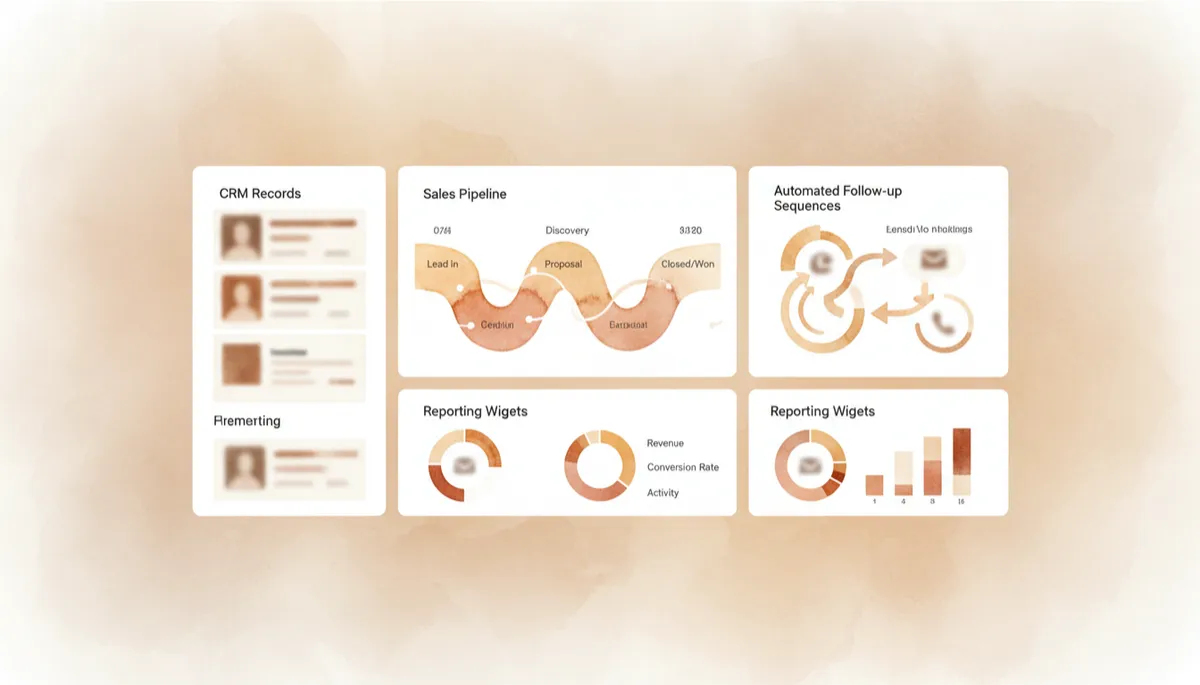
A connected operating system turns scattered tools into one clear, manageable view.
The Hidden Cost of Accumulating Separate Applications
Many small businesses slowly accumulate apps over time: a CRM, a texting tool, an email platform, a scheduling link, a review tool, and a project system. Each one might be helpful, but together they often create:
Fragmented information – Customer details, notes, and history are spread across multiple systems, making it hard to see the full picture.
Duplicate data entry – The same contact or job is re-entered into multiple tools, wasting time and increasing errors.
Missed handoffs – Leads or customers stall because there is no clear, automated next step between systems or team members.
Inconsistent processes – Each person develops their own way of working, making results unpredictable and training difficult.
Rising subscription costs – Multiple small tools add up to a significant monthly spend without delivering a unified system.
Poor visibility – It is difficult to answer, in one place, what is happening across marketing, sales, and operations.
A business operating system like SYNTRO-OS is designed specifically to eliminate this fragmentation by centralizing data and workflows instead of spreading them across disconnected tools.
Software Is Not the Same as a Business System
It is easy to confuse “we bought software” with “we built a system.” They are not the same thing. Software provides tools. A business system defines how those tools are used to consistently produce results.
A real business system includes:
Clear process steps – What happens first, second, and third for each type of work (lead, job, project, renewal, etc.).
Defined ownership – Who is responsible at each stage and what “done” looks like for them.
Specific triggers – Events that move work forward, such as “new lead captured,” “proposal sent,” or “invoice overdue.”
Built-in automation – Follow-up messages, reminders, and tasks that happen automatically based on those triggers.
Measurable outcomes – Clear metrics such as response time, close rate, and on-time delivery that show whether the system is working.
SYNTRO Software emphasizes business systems implementation, not just access to features. SYNTRO-OS is built to help you define and run these processes, not leave you with a blank set of tools to figure out on your own.
Major Components of a Modern Business Operating System
While every company is different, most modern business operating systems share a common set of components. Together, they support the full customer journey and internal operations:
Customer Management (CRM): Centralized records for every contact, lead, customer, and account, including notes, communication history, and documents.
Sales Pipelines: Visual stages that show where each opportunity stands, who owns it, and what needs to happen next to move it forward.
Lead Capture: Forms, landing pages, call tracking, and integrations that feed leads directly into your operating system without manual entry.
Automated Follow-Up: Email and SMS sequences, reminders, and tasks that ensure every lead and customer is followed up with consistently and on time.
Communications Hub: Centralized email, SMS, and call logging so conversations are visible to the team—not locked in individual inboxes and phones.
Scheduling: Appointment booking, reminders, and calendar management that tie directly into the customer record and workflow steps.
Marketing and Campaigns: Email campaigns, nurture sequences, and promotions connected to your CRM and reporting—not a separate list in another tool.
Workflows and Process Automation: Rules that move work from stage to stage, assign tasks, and trigger communication when specific events occur.
Reporting and Dashboards: Real-time views of activity, conversion rates, workload, and performance, so leaders can make informed decisions quickly.
Customer Experience and Reputation: Feedback collection, reviews, and satisfaction tracking that tie back into your operating system, not a separate silo.
Operational Visibility: Management views into workloads, bottlenecks, and process compliance across teams and locations.
SYNTRO-OS brings these components together into a single, AI-enabled platform so you are not trying to assemble your own operating system from disconnected parts.
Signs Your Business Has Outgrown Its Current Systems
How do you know it is time to move to a true business operating system? Common warning signs include:
Leads fall through the cracks because there is no consistent tracking or automated follow-up process.
Team members rely on memory or personal notes to remember who to call, what to send, and what comes next in a job or project.
The owner or manager is constantly asked, “What should I do now?” or must personally follow up on every important step.
There is duplicate data entry into multiple tools just to complete a single customer journey from lead to invoice.
Communication with customers is inconsistent, varying widely from one team member to another or from one week to the next.
You rely on disconnected applications that do not share data well, making reporting and management visibility difficult or impossible.
There are few or no documented workflows, so training new staff takes too long and is inconsistent across roles or locations.
Leaders do not have a single source of truth for activity, pipeline, and performance, leading to guesswork instead of decisions based on data.
When these signs appear, adding another isolated app will not solve the root problem. What you need is a connected operating system that supports how your business actually runs.
How AI Is Transforming Business Operating Systems
Artificial intelligence is reshaping what a business operating system can do. Instead of just storing data and running simple automations, AI-enabled platforms like SYNTRO-OS can actively help teams work smarter. Practical uses include:
Customer communication: Drafting personalized emails or SMS messages, suggesting responses, and helping standardize tone and clarity across the team.
Information analysis: Reviewing activity, pipeline, and performance data to highlight trends, bottlenecks, or opportunities that deserve attention.
Content creation: Assisting with proposals, follow-up sequences, marketing messages, and documentation based on your existing templates and processes.
Sales support: Suggesting next best actions, identifying at-risk deals, and summarizing conversations so sales teams can focus on relationships, not admin work.
Workflow improvement: Highlighting steps where work frequently stalls and suggesting process changes or new automations to keep things moving.
Knowledge access: Making internal documentation, procedures, and best practices easier to find and apply inside the tools your team already uses.
Automating repetitive tasks: Handling routine follow-ups, reminders, and updates so your team can focus on higher-value work.
AI does not run your entire company automatically, nor should it. What it does—especially inside a structured operating system—is augment your team, reduce manual workload, and give leaders better information faster. SYNTRO Software’s AI-first approach is built around this principle: use AI to enhance a well-designed business system, not replace human judgment and leadership.
Introducing SYNTRO-OS: A Business Operating System for Growing Companies
SYNTRO-OS is SYNTRO Software’s business operating system, designed to unify your core business functions into a single, intelligent environment. It goes beyond traditional software by focusing on how your business operates—and then building the technology around those workflows.
With SYNTRO-OS, you can:
Centralize customer data into a single record that includes contact information, communication history, deals, tasks, and documents—reducing duplication and confusion.
Organize sales pipelines with clear stages, ownership, and automation, so you can see exactly where every opportunity stands and what needs to happen next.
Automate follow-up with structured sequences for new leads, quotes, no-shows, renewals, and more, ensuring consistent communication without manual chasing.
Create workflows for onboarding, service delivery, project handoffs, and internal approvals, so work moves smoothly between team members and departments.
Manage communication across email, SMS, and calls from one place, connected to the right customer and workflow stage, improving both responsiveness and context.
Improve visibility with dashboards and reports that show real-time activity, pipeline health, workload, and performance across teams and locations.
Standardize processes so each customer receives a consistent experience, and each team member follows the same, proven steps supported by automation and AI.
Reduce reliance on disconnected tools by consolidating key functions into one operating system, simplifying your tech stack and lowering complexity.
SYNTRO-OS is part of the broader SYNTRO Software ecosystem, which also includes applications for content creation, marketing, estimating, process documentation, operational control, and sales support. Together, they provide an AI-driven foundation for running and scaling your business with less friction and more control—while keeping this guide focused on education, not just features.
Where to Start: Map Your Major Workflows Before You Automate
Moving to a business operating system does not mean automating everything overnight. The most successful implementations start with clarity about how the business already operates—or how it should operate. Before you choose tools or build automations, identify your major workflows, such as:
Lead capture and qualification – How do leads arrive? What information do you need? Who reviews and responds to them, and within what timeframe?
Sales and estimating – How do you move from initial conversation to proposal or quote, and then to a signed agreement or approved job?
Onboarding – What happens when a customer says “yes”? What information do you collect, and how do you set expectations and next steps?
Service delivery or project execution – How is work scheduled, assigned, tracked, and reviewed? How do you communicate progress to customers or stakeholders?
Communication and updates – When and how do you update customers, send reminders, share documents, or request approvals and feedback?
Billing and collections – How do you invoice, follow up on payments, and handle renewals or recurring services?
Follow-up and retention – How do you stay in touch after a project is complete or a service is delivered to encourage repeat business and referrals?
Once these workflows are mapped, a platform like SYNTRO-OS can help you build a connected operating system around them—tying together CRM, communication, scheduling, tasks, and reporting in a way that matches how your business actually works. The technology should support your processes, not force you into generic templates that do not fit your operations.
The Real Value of a Business Operating System
At its core, a business operating system is about enabling growth without requiring the owner or leadership team to personally manage every detail. When your processes, data, communication, and workflows are unified, you gain:
Structure – Clear, repeatable ways of working that do not change from person to person or day to day.
Visibility – Real-time insight into what is happening across marketing, sales, operations, and customer experience, so you can lead with confidence.
Automation – Intelligent support for your team that reduces manual work, speeds up response times, and improves consistency across the business.
Instead of reacting to problems, you can proactively design how your business runs—and then rely on your operating system to execute that design every day. That is the shift from “holding everything together” to scaling with confidence.
Take the Next Step with SYNTRO-OS and SYNTRO Software
If you recognize the signs—disconnected tools, manual follow-up, scattered customer information, and a growing dependence on the owner—it is time to consider a business operating system built for modern growth. SYNTRO-OS from SYNTRO Software is designed to unify your core business functions, implement real business systems, and leverage AI to help your team do more with less effort.
Whether you are a contractor, manufacturer, construction firm, service business, or professional services organization, SYNTRO Software helps you build connected systems for marketing, sales, communication, operations, and growth—all in one intelligent platform.
If you are ready to move beyond disconnected apps and manual processes, start your free trial of SYNTRO-OS or schedule a personalized demonstration to see how an AI-driven business operating system can create the structure, visibility, and automation your business needs to scale with confidence.


