Build Business Systems for Independence
Business Systems, Operations, Automation, SYNTRO Software
How to Build Business Systems That Let Your Company Run Without Everything Depending on You
When your business is growing, success can create a new problem: everything starts to depend on you or a few key people. Building effective business systems is how you break that dependency and create a company that runs reliably, even when you are not in the room. This guide explains what business systems really are, how to design and document them, and how technology, automation, and AI—supported by platforms like SYNTRO Software—turn them into a scalable operating engine for growth.
The Relatable Reality: When Growth Outruns Your Systems
Imagine Sarah, who runs a fast-growing service company. Revenue is up, the phone never stops ringing, and new projects keep coming in. But every decision, every customer exception, every urgent issue still finds its way back to her. Salespeople promise things only Sarah can approve. Project managers text her for answers late at night. Invoices wait because only she knows how to “fix” the numbers in the accounting software.
Sarah has good people and many tools, but she does not have systems. Her business has grown faster than the underlying structure that should support it. The result is owner dependency, constant firefighting, and a ceiling on growth. This is where deliberate business system design changes everything.
Key Concepts: Tasks, Processes, SOPs, Workflows, Automation, and Business Systems
Before building systems, it is essential to use clear language. Many owners mix up tools, documents, and systems. The distinctions below keep everyone aligned and make design far easier.
Task: A single unit of work performed by a person or machine. Example: “Call new lead,” “Send proposal,” or “Create invoice draft.”
Process: A sequence of related tasks that together achieve a result. Example: The steps from receiving a signed proposal to issuing an invoice and collecting payment.
SOP (Standard Operating Procedure): A documented, detailed description of how to perform a task or process. It tells someone exactly what to do, in what order, and to what standard. SOPs are instructions, not the system itself.
Workflow: The practical flow of work between people, tools, and steps—who does what, when, and in what system. Workflows operationalize processes and often live inside software like SYNTRO-OS, your CRM, or project tools.
Automation: Rules and logic that allow software or AI to perform tasks or decisions without manual effort. Example: automatically assigning a new lead, sending follow-up reminders, or generating a quote based on data inputs.
Business System: A repeatable method for producing a defined business outcome. It includes people, tasks, processes, SOPs, workflows, tools, data, automation, and performance measures—all working together to reliably deliver a result. The system is the whole engine, not just one document or one piece of software.
📌 Key Takeaway: A business system is not just software or a stack of SOPs. It is the complete, connected way your company achieves a specific result, consistently and predictably.
A Practical Example: The Lead-to-Customer System
Consider one of the most important systems in any growing company: turning leads into paying customers. A Lead-to-Customer System is more than a salesperson’s inbox or a CRM license—it is the complete, repeatable method for moving someone from “interested” to “signed and onboarded.”
Defined outcome: A qualified lead becomes a paying, onboarded customer within a target timeframe and margin.
Core tasks: Capture lead, qualify, schedule discovery, prepare proposal, follow up, close, hand off to delivery, trigger billing.
SOPs: How to qualify a lead, how to price a proposal, how to enter data in the CRM, how to hand off to operations.
Workflow and automation: Automatically route leads to the right salesperson, create follow-up tasks, send reminders, and trigger onboarding tasks when a deal is marked “won.”
Measurement: Conversion rate, average sales cycle, win rate by source, and average revenue per customer.
When these elements are designed and connected inside a platform like SYNTRO-OS, you do not rely on one salesperson’s memory or personal style. The system itself ensures leads are handled consistently, and performance is visible to you in real time.
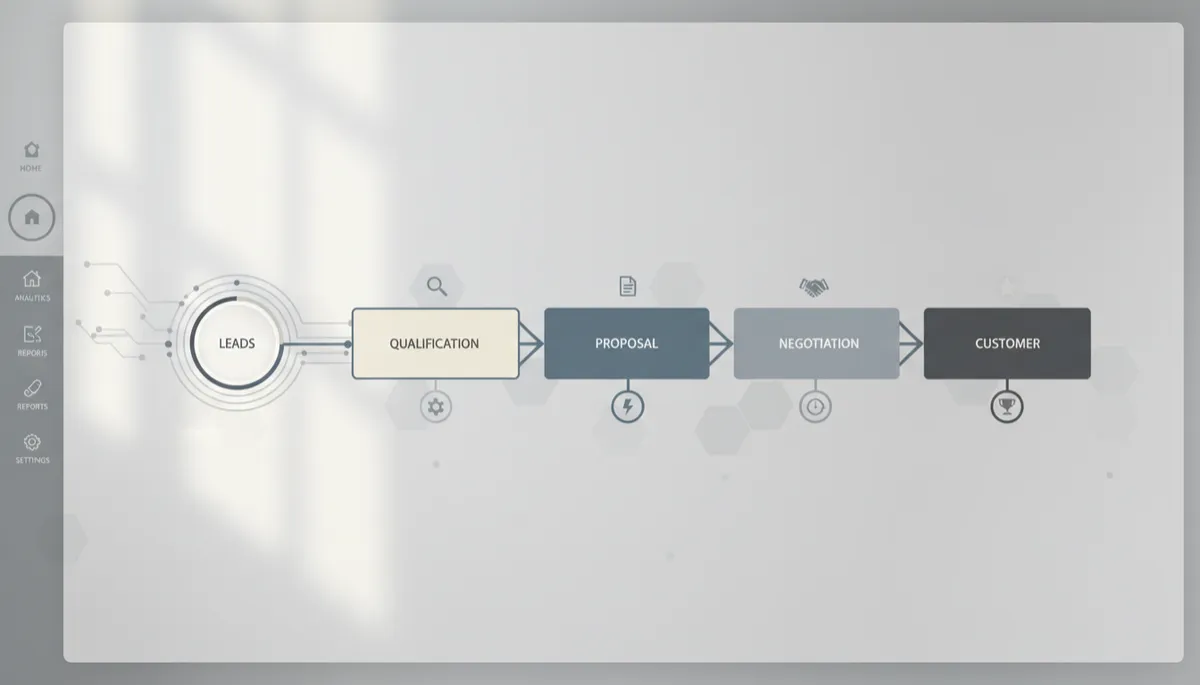
Visualizing your lead-to-customer system exposes bottlenecks and standardizes how growth happens.
The Core Business Systems Every Growing Company Needs
While every business is unique, most growing companies share a common set of core systems. Together, these form the foundation of a true business operating system:
Lead-to-Customer System: Marketing, sales, and onboarding working together to turn interest into revenue.
Service or Product Delivery System: How you consistently deliver what you sold—projects, manufacturing runs, service visits, or ongoing support—on time and to standard.
Financial and Billing System: From agreed pricing to accurate invoicing, collections, cost tracking, and reporting, including integration with accounting tools.
Customer Success and Support System: How you respond to issues, manage renewals, gather feedback, and protect long-term relationships and lifetime value.
People and Talent System: Recruiting, onboarding, training, performance management, and knowledge transfer so new team members can plug into existing systems quickly.
These systems should not exist as isolated departments. In an effective business operating system, they are connected. A closed sale flows directly into delivery, which triggers billing, which informs financial reporting, which guides future decisions. SYNTRO-OS is designed to unify these flows in one intelligent environment rather than forcing you to stitch together disconnected tools.
Owner Dependency: When the Business Grows Faster Than Its Systems
Owner dependency usually appears when revenue and headcount grow, but systems do not. The company becomes a collection of individual heroics rather than a coordinated machine. Decisions sit in the owner’s head. Exceptions require their approval. The “system” is memory, improvisation, and a patchwork of spreadsheets, emails, and chat messages.
Delegation without systems feels like relief at first—until quality drops, customers complain, and you are pulled back in to fix problems. The underlying risk is clear:
Work is delegated, but expectations are not defined, so outcomes vary wildly between people and projects.
New hires rely on shadowing and guesswork because there is no documented or automated way of working to plug into.
The owner becomes the “exception handler” and ultimate safety net, which prevents real freedom and caps scale.
⚠️ Warning: Delegation without proper systems does not create leverage—it creates risk. You trade your time for inconsistency, rework, and reputation damage.
A Step-by-Step Process for Building a Business System
Building business systems is a disciplined, repeatable effort. Below is a practical framework you can apply to any area—starting with your highest-impact processes.
1. Define the Business Outcome
Start with clarity: What result should this system consistently produce? For example, “Issue accurate invoices within three days of project completion and collect payment within 30 days.” The outcome becomes the north star for every design decision that follows.
2. Map the Current Process and Tasks
Document how work is actually done today, step by step. Capture:
Each task in order, from trigger to completion.
Who does it and in which tool (spreadsheet, email, software, etc.).
What information is needed at each step and where it comes from.
Do not design yet—observe and capture. This becomes your baseline.
3. Identify Breakdowns, Bottlenecks, and Risks
Look for delays, errors, and owner dependencies. Ask:
Where do tasks wait on one person’s approval or knowledge?
Where do mistakes frequently occur or information get lost?
Which steps are repetitive and rule-based (ideal for automation)?
4. Design the Ideal Future-State Process
Now, design how the system should work to consistently achieve the outcome. Simplify steps, remove unnecessary handoffs, and define clear ownership. Focus on:
Standard decision rules (so people do not have to guess or escalate everything).
Clear triggers for when a process starts and ends.
How information will move between steps and systems.
5. Document SOPs for Critical Tasks
Translate the designed process into practical SOPs for the most important tasks. Each SOP should answer:
What is the purpose of this task?
Who is responsible for it?
What are the exact steps, inputs, and outputs?
Remember: SOPs are components of the system, not the system itself. They guide human work inside the broader structure of workflows, tools, and automation.
6. Design Workflows and Then Add Automation
Only after the process is clear should you design digital workflows and automation. In platforms like SYNTRO-OS, you can:
Create standardized workflows that assign tasks, set due dates, and move work between teams automatically.
Automate notifications, approvals, and document generation based on rules you define.
Ensure data flows seamlessly between CRM, operations, accounting, and communication channels.
💡 Pro Tip: Automation should follow process design, not replace it. Automating a broken or unclear process only helps you make mistakes faster.
7. Define Metrics and Feedback Loops
Every business system needs measurable performance indicators. For example:
Lead-to-customer system: conversion rate, average time to close, cost of acquisition.
Delivery system: on-time completion rate, rework percentage, customer satisfaction scores.
Use dashboards and reports to monitor these metrics. Platforms like SYNTRO-OS bring data from across your systems into one intelligent view so you can see how the entire operating environment is performing.
8. Implement, Train, and Continuously Improve
Roll out the new system with clear communication: why it exists, how it works, and what success looks like. Train your team on both the SOPs and the workflows. Then:
Collect feedback from users on what works and what creates friction.
Review performance metrics regularly and make targeted improvements.
Systems are living assets. As your business evolves, your systems should evolve with it—especially when your operating environment is centralized and configurable, as it is in SYNTRO-OS.
How Technology and Automation Support Business Systems
Technology does not replace the need for business systems; it enables them to operate at scale. The right platform supports your designed processes instead of forcing you into rigid templates. SYNTRO Software’s AI-driven operating system, SYNTRO-OS, is built around this principle: your processes first, then intelligent automation and integration around them.
Unification: CRM, operations, accounting, and communication live in a single environment, so data and workflows connect instead of fragmenting across tools.
Automation-first: Routine tasks, follow-ups, and handoffs are automated according to rules you define, reducing manual work and human error.
Visibility: Real-time dashboards show how systems are performing, enabling proactive management instead of reactive firefighting.
How AI Supports Business Systems (Without Replacing Them)
AI is a powerful enhancer of business systems when used correctly. It should not be viewed as a black box that “runs the business,” but as an intelligent assistant embedded in your operating system. In SYNTRO-OS, AI can:
Analyze patterns in your processes to highlight bottlenecks or predict delays before they impact customers.
Recommend next-best actions in workflows, such as which leads to prioritize or which customers may be at risk of churn.
Generate draft documents, emails, or reports based on your existing SOPs and data, which your team can review and finalize.
AI amplifies well-designed systems. It cannot compensate for the absence of clear processes, roles, and outcomes. Your job is to design the system; AI, embedded in a platform like SYNTRO-OS, helps it run smarter and faster.
From Individual Systems to a Connected Business Operating System
Over time, your individual systems—lead-to-customer, delivery, billing, support, and talent—should not remain isolated. When they integrate, they form a business operating system: the connected backbone that runs your company end to end.
Sales commitments automatically inform delivery schedules and capacity planning.
Completed work automatically triggers accurate billing and updates financial forecasts.
Customer feedback flows back to sales, delivery, and product improvement loops.
SYNTRO-OS is built to support exactly this evolution. Instead of forcing you into one rigid way of working, it provides a connected operating environment where your systems can be modeled, automated, integrated, and improved over time. Technology serves your design, not the other way around.
Why Connected Processes Matter More Than Isolated Departments
Many companies are organized around departments—sales, operations, finance—but customers experience processes, not org charts. A disconnected handoff between sales and delivery, or delivery and billing, is what causes delays, frustration, and rework. Connected processes solve this by aligning everyone around shared outcomes and shared data.
Teams see the same information, updated in real time, instead of working from conflicting versions of the truth.
Work moves smoothly between roles and systems because workflows and automations handle the transitions.
Accountability is clear: each system has defined owners, metrics, and standards.
A connected operating system like SYNTRO-OS makes these cross-functional processes visible and manageable, so your company behaves as one coordinated entity rather than a collection of silos.
Start Small: Focus on High-Impact Processes First
Building a complete business operating system does not happen overnight—and it does not need to. The most effective approach is to start small and strategic. Identify one or two high-impact processes where owner dependency and inconsistency hurt the most. Common starting points include:
Lead intake and qualification, where opportunities are lost due to slow or inconsistent follow-up.
Project kickoff and handoff from sales to operations, where miscommunication creates rework and delays.
Invoicing and collections, where cash flow is constrained by manual, error-prone steps.
Apply the step-by-step framework to these areas, implement them in a platform like SYNTRO-OS, and then progressively build and connect additional systems. Each completed system reduces reliance on memory and improvisation, while each integration increases overall leverage.
The Payoff: Predictable Growth Without Constant Heroics
When your business runs on well-designed, connected systems, everything changes. Work no longer depends on one person’s availability or memory. Accountability is built into the way work flows. New hires can contribute faster because they step into defined roles within existing systems, supported by clear SOPs, automation, and AI-driven guidance.
Most importantly, growth becomes predictable. You can see which systems are performing, where to invest, and how to scale without multiplying chaos. Instead of spending your days fighting fires, you spend your time improving the machine that prevents them.
Build Your Connected Operating System with SYNTRO Software
SYNTRO Software exists to help business owners like you build the systems that let your company run reliably without everything depending on you. SYNTRO-OS is an AI-powered, all-in-one operating system that unifies CRM, operations, accounting, and communications into a single intelligent environment. It is designed to support your business systems—not force you to redesign your business around disconnected tools.
With SYNTRO-OS, you can model your processes, document SOPs, orchestrate workflows, apply automation, and leverage AI insights across your entire organization. The result is a connected business operating system that reduces unnecessary dependence on memory and improvisation, strengthens accountability, and enables sustainable, predictable growth.
If you are ready to move beyond owner dependency and build the systems your business deserves, start with SYNTRO-OS today or schedule a personalized demonstration with SYNTRO Software. Discover how SYNTRO-OS can help you design and run connected business systems, automation, and operational infrastructure that let your company grow faster—while you do less of the day-to-day heavy lifting.


