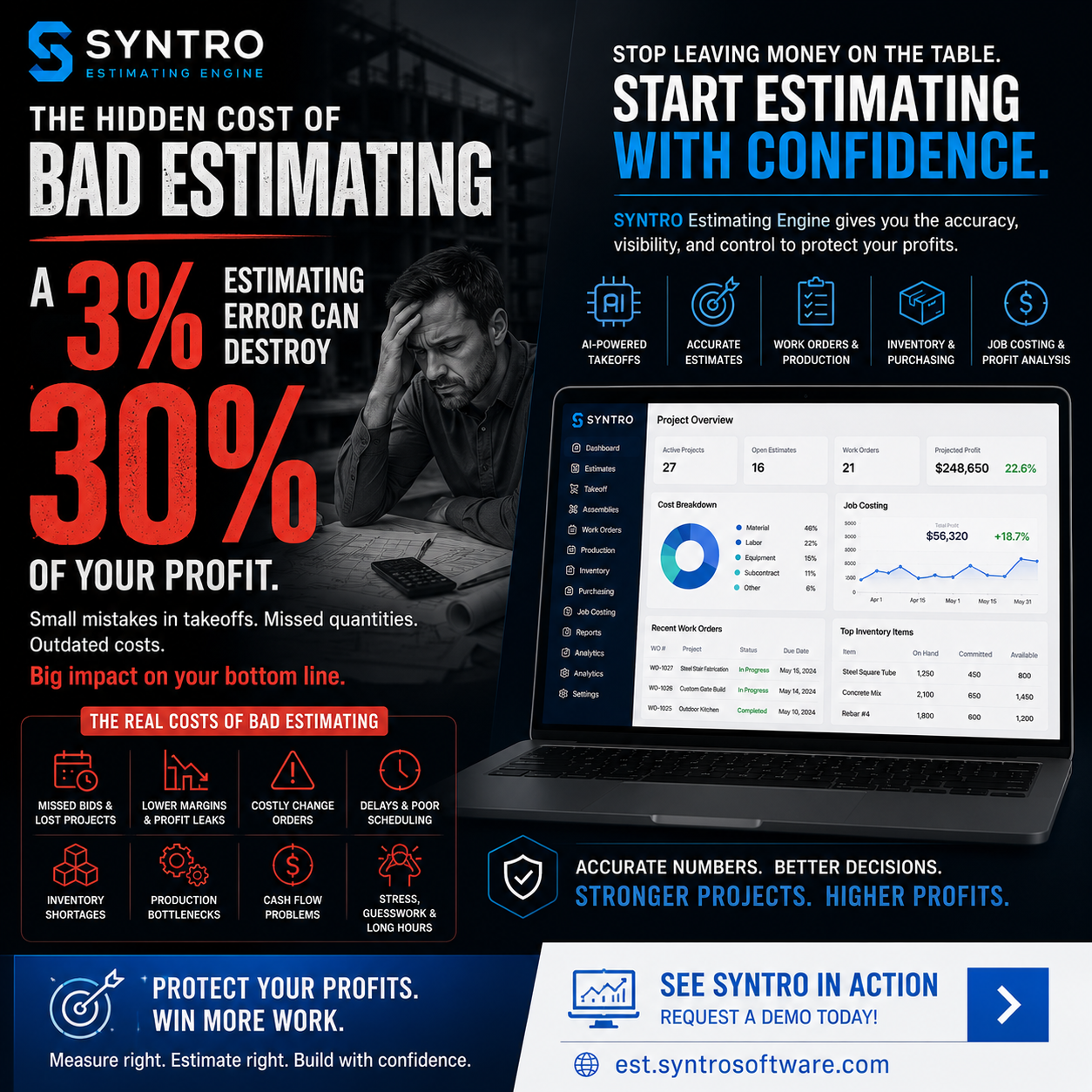
AI Revolutionizing Construction Estimating
Construction, Estimating, Artificial Intelligence, SYNTRO Software
How AI is Reshaping the Future of Estimating
Estimating in construction and specialty trades is undergoing the same transformation that quantitative finance went through a decade ago: a shift from manual, intuition-driven work toward disciplined, data-informed workflows. For contractors, estimators, and project managers, artificial intelligence is not a replacement for experience—it is leverage for it.
From Manual Estimating to Data-Driven Workflows
In trading, the edge moved from traders manually scanning charts to algorithms continuously reading the market. Estimating is following a similar path. For years, many contractors and specialty trades have relied on a familiar toolkit: printed plans or PDFs, highlighters, spreadsheets, and experience. That approach can work—but it does not scale, and it is increasingly outmatched by project complexity and client expectations for speed and accuracy.
AI-assisted estimating tools now analyze drawings, specifications, and historical project data the way quantitative models analyze market feeds. According to recent industry outlooks, more than two-thirds of general contractors are using AI-assisted estimating in some form, and error bands are tightening from roughly ±15% toward ±6% when AI is paired with strong cost data and human review. The result is not just faster estimates—it is a more disciplined, evidence-based pricing process that looks far more like a trading desk than a back-office spreadsheet exercise.
The Persistent Pain Points in Traditional Estimating
Before discussing what AI improves, it is important to be explicit about the problems it is being asked to solve. Across contractors, construction companies, and specialty trades, the same friction points appear repeatedly:
Manual plan review: Estimators spend hours visually scanning drawings, counting fixtures, measuring runs, and cross-checking details across sheets and revisions.
Repetitive data entry: Quantities are retyped into spreadsheets or estimating software, often multiple times as scope changes or alternates are requested.
Missed materials or labor: A forgotten line item, an overlooked detail on a sheet, or an assumption that is not documented can quietly erode margin when the project is underway.
Inconsistent pricing: Different estimators (or even the same estimator on different days) may use different production rates, markups, or assemblies for similar work, making job-to-job profitability unpredictable.
Slow turnaround times: When estimates take weeks, opportunities are lost, and clients move on. In competitive markets, speed is a strategic advantage, much like speed to market in trading.
Estimating errors: Manual calculations, copy-paste mistakes, or formula errors in spreadsheets can swing results by thousands of dollars without being obvious until it is too late.
Weak handoff to operations: Even when the estimate is accepted, converting numbers into clear work orders, purchasing plans, labor schedules, and job cost tracking is often fragmented or manual. The “trade” is executed without a clean connection to the “trade idea.”
These issues do not simply increase workload—they introduce volatility into your business, just as inconsistent position sizing and sloppy execution would on a trading desk. AI, when implemented correctly, is a way of tightening those controls and reducing variance.
How AI Changes the Estimating Workflow in Practice
In finance, algorithmic strategies break a complex decision into a series of smaller, rules-based steps: read the data, identify patterns, size the position, manage risk, and monitor outcomes. AI-driven estimating is evolving along similar lines. The goal is not one monolithic “magic button,” but a set of intelligent tools that assist experienced estimators at each stage of the workflow.
1. Analyzing Project Information and Drawings
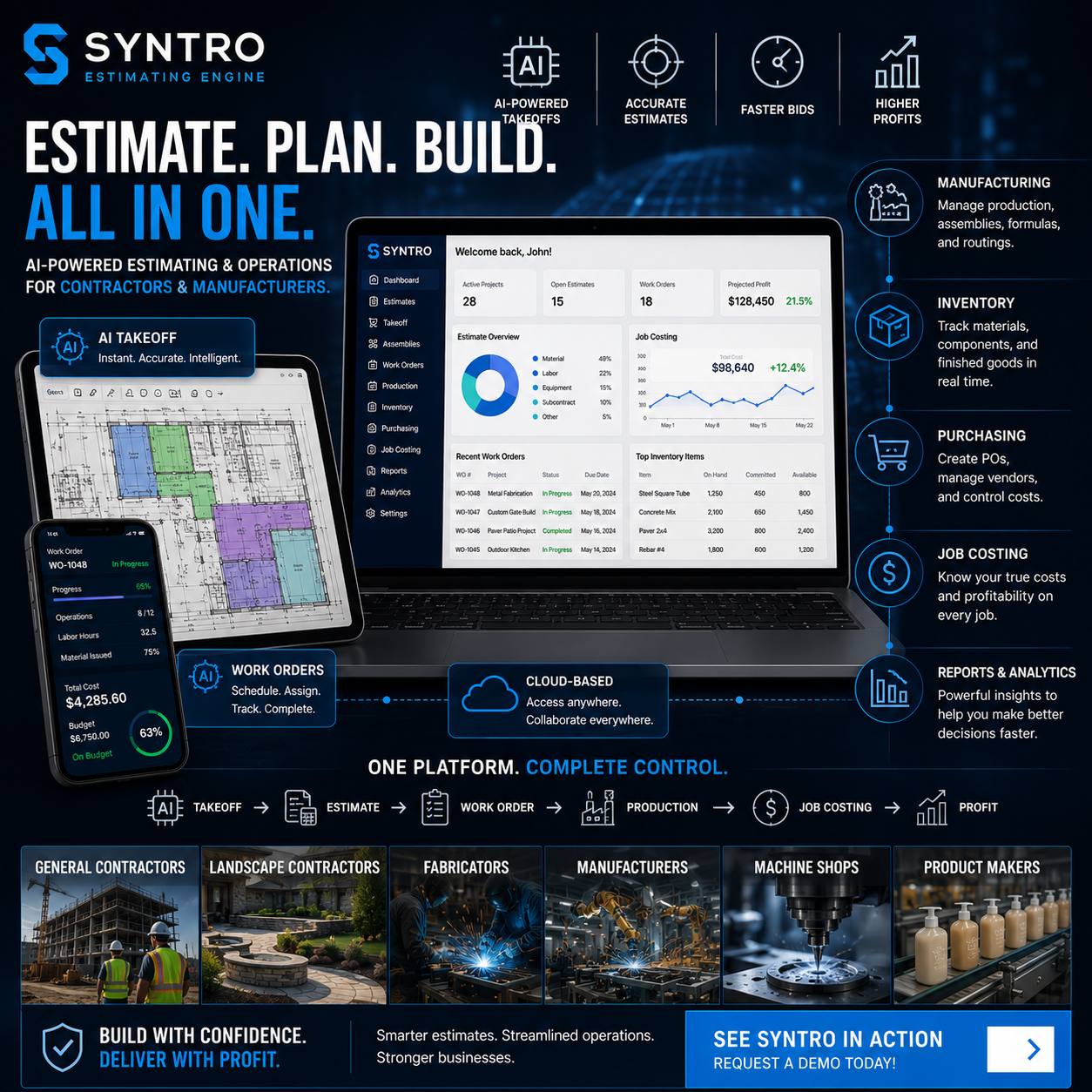
Modern computer vision models can scan digital plans and identify symbols, layers, and building elements in minutes. Similar to how pattern-recognition algorithms detect recurring structures in price data, AI takeoff engines recognize fixtures, conduit runs, walls, openings, and more. Industry tools report that up to 80% of basic takeoff work can be automated on clean plans, allowing the estimator to focus on exceptions and judgment calls rather than raw counting.
2. Assisting with Quantity Takeoffs and Assemblies
Once elements are detected, AI can propose quantities and assemblies automatically. For example, an AI-assisted system may:
Convert detected linear footage of piping into a complete assembly including fittings, hangers, insulation, and labor.
Suggest typical labor hours per unit based on your historical production rates for similar work.
Flag unusual quantities or unit rates that deviate significantly from your norms, much like a risk engine flagging outlier trades.
The estimator remains in control—reviewing, adjusting, and approving—but the heavy lifting of measurement and assembly suggestion is accelerated dramatically.
3. Identifying Relevant Materials, Labor, and Potential Omissions
AI models can cross-reference project scope with your historical database to suggest the materials and labor typically required for similar jobs. They can also detect common omissions, such as:
Missing trim or finish items that usually accompany a certain fixture.
Access equipment or mobilization costs that were included on comparable projects but are absent from the current estimate.
Labor allowances for testing, commissioning, or cleanup that often get overlooked when deadlines are tight.
In trading terms, this is akin to a pre-trade risk check: ensuring that your “position” in a job includes all the exposures you are actually taking on, not just the obvious ones.
4. Using Historical Information to Improve Consistency and Pricing
A core advantage of AI is its ability to learn from your own data. When estimates are consistently linked to job costing and actual performance, AI can:
Recommend production rates that reflect how your crews actually perform, not just generic book values.
Highlight which assemblies or project types tend to underrun or overrun, guiding more realistic allowances in future estimates.
Support scenario analysis—how margin changes if labor efficiency slips by a few percentage points, or if material prices move against you.
This mirrors how quantitative funds constantly recalibrate models based on realized P&L, volatility, and slippage. The objective is not perfection; it is continuous calibration toward more reliable outcomes.
5. Speed: Turning Around More Bids Without Lowering Standards
AI’s most visible benefit is time. Studies of AI-assisted takeoff tools report 50–60% reductions in manual takeoff time. When combined with smart assemblies and historical data, experienced estimators can move from first review to a defensible, consistent estimate far faster than before. In business terms, this is equivalent to increasing your “trade volume” without increasing risk—submitting more bids, with less fatigue, while maintaining discipline.
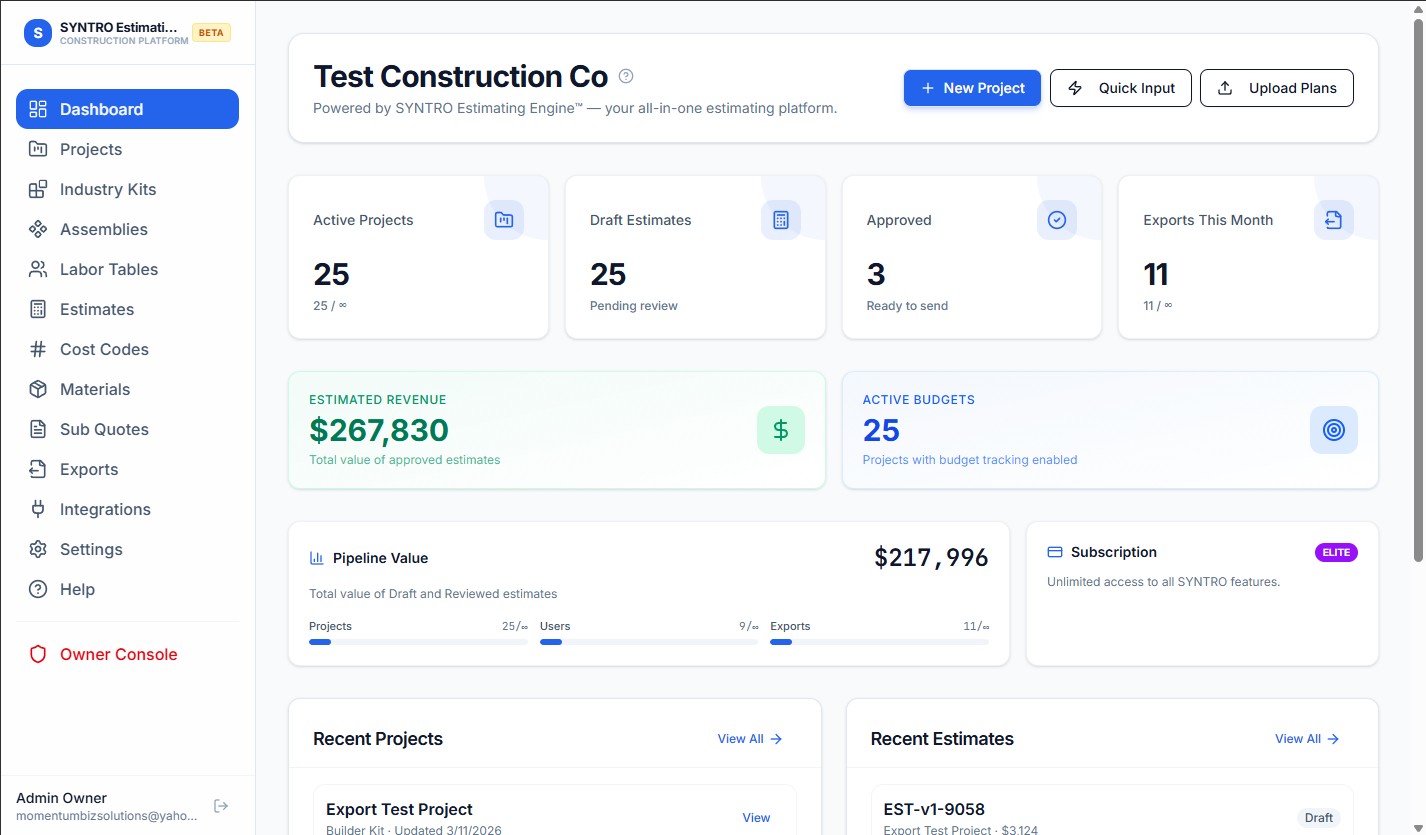
Firms using AI-assisted estimating often reallocate hours from data entry to higher-value review and strategy.
AI as Co-Pilot, Not Autopilot: The Role of Human Oversight
In financial markets, fully automated strategies are tightly risk-managed and continuously monitored. Even then, experienced portfolio managers step in when markets behave in unexpected ways. Estimating is no different. AI can accelerate both good and bad decisions; the differentiator is governance and human judgment.
📌 Key Takeaway: The most successful firms are adopting a “hybrid estimator” model—experienced professionals using AI to handle repetition, while they retain responsibility for scope, risk, and strategy.
Reviewing AI-Generated Recommendations
Every AI suggestion—whether a quantity, assembly, or production rate—should be treated as a recommendation, not a fact. Estimators should:
Validate assumptions on complex or unusual scopes, just as a trader double-checks large or atypical orders.
Spot-check quantities and key assemblies against the drawings and specifications, especially on critical path items.
Document overrides and rationale, building a feedback loop that improves future AI performance.
Maintaining Accurate Cost Databases and Local Adjustments
AI is only as reliable as the data it works with. For estimators, that means:
Keeping material prices, labor rates, and production data current, with clear version control and approval processes.
Applying regional and local adjustments to reflect market conditions, union vs. non-union labor, site access, climate, and other job-specific factors that generic models cannot fully capture.
Periodically reconciling estimated vs. actual costs to calibrate both the database and the AI recommendations.
In trading, this would be the equivalent of maintaining clean market data and transaction cost models; without that, even the best algorithms drift off target.
Beyond “What’s the Price?” – The Future of Estimating
In finance, a trade is not just a quote; it is a lifecycle: idea generation, execution, risk management, and post-trade analytics. Estimating is similar. The number at the bottom of the estimate is important, but by itself it is incomplete. The real value lies in how that number connects to everything that follows once the customer says “yes.”
Modern estimating software should therefore be designed around a connected workflow, not as a standalone calculator. A forward-looking estimating platform should:
Generate professional proposals directly from the estimate, with clear options, inclusions, and exclusions.
Turn accepted proposals into work orders and change orders without re-keying information, maintaining a single source of truth for scope and pricing.
Feed labor planning with quantities and production rates so that crews, shifts, and milestones are grounded in the original estimate rather than ad hoc assumptions.
Drive purchasing and inventory workflows by converting estimated materials into purchase suggestions, stock reservations, and delivery schedules aligned with the project timeline.
Connect to invoicing and job costing, so that billing events and cost tracking are aligned to the same structure used in the estimate, enabling clear variance analysis.
Provide reporting and analytics that show, project by project, where estimates are accurate, where they drift, and where process improvements will yield the greatest return.
In other words, the estimate should function as the central “trade ticket” for the entire job lifecycle—connecting sales, operations, field execution, and finance in a single, coherent flow.
A Quantitative Lens: Comparing Manual vs. AI-Assisted Estimating
To illustrate the shift, consider a simplified comparison between traditional manual estimating and an AI-assisted, connected workflow. The figures below are indicative, based on reported industry improvements and internal benchmarks, and will vary by firm and project type:
Metric Manual-Centric Workflow AI-Assisted, Connected Workflow Typical takeoff time for medium project 16–24 hours 6–10 hours (with AI pre-processing and review) Error band on total cost (conceptual) ±12–15% ±6–8% (with good data and oversight) Time to issue proposal after drawings received 1–3 weeks 2–5 days (depending on complexity and revisions) Re-keying of data into downstream systems Multiple manual entries (proposal, work orders, purchasing, invoicing) Minimal; estimate drives proposals, work orders, purchasing, and job costing
From a financial analyst’s perspective, the AI-assisted model reallocates time from low-value tasks (counting, retyping, reconciling) to higher-value activities (scope analysis, risk evaluation, strategy). This is the same pattern seen when trading desks moved from manual ticket entry to electronic execution and algorithmic support.
SYNTRO Estimating Engine: A Connected, AI-Enabled Approach
SYNTRO Software is building its Estimating Engine around this connected, AI-assisted philosophy. Rather than treating estimating as a siloed function, SYNTRO’s platform is designed as part of an enterprise AI operating system that unifies CRM, operations, accounting, and communications into a single, intelligent environment.
The SYNTRO Estimating Engine includes capabilities such as AI-assisted plan takeoffs, reusable assemblies, production rates, and formula-based calculations. These tools are intended to help estimators move faster and with greater consistency, while still relying on their professional judgment to interpret scope, adjust for local conditions, and manage risk. Recent performance improvements have focused on enabling complex, multi-phase estimates to be processed more efficiently, reducing bottlenecks for busy teams.
Importantly, SYNTRO is being designed around a connected estimate-to-operations workflow. The same estimate that drives your proposal can flow forward into:
Project management and work orders, so field teams see the same structure and assumptions used in the bid.
Change order workflows, ensuring that scope changes are priced consistently with the original estimate and tracked clearly over time.
Purchasing, inventory, and manufacturing or fabrication workflows, where applicable, so that material planning is grounded in the quantities and assemblies you have already validated.
Job costing and reporting, enabling you to compare estimated vs. actual performance and feed that insight back into future estimates and AI recommendations.
For contractors and SMBs, this connected model mirrors the integrated front-to-back systems that institutional trading firms rely on—where the order management system, risk engine, and accounting stack operate on the same underlying data. The objective is straightforward: fewer handoffs, fewer errors, and a clearer view of profitability across the entire lifecycle of each job.
Looking Ahead: Equipping Estimators, Not Replacing Them
The firms that have benefited most from AI in finance were not those that eliminated human decision-makers; they were the ones that gave their professionals better tools, better data, and more connected workflows. The same pattern is emerging in construction and specialty trades. AI is reshaping estimating by:
Automating repetitive, error-prone tasks like plan reading, counting, and basic calculations.
Providing data-driven recommendations on assemblies, production rates, and potential omissions, grounded in your own history rather than guesswork.
Connecting the estimate to proposals, operations, purchasing, and job costing, turning a single project view into a continuous feedback loop.
But AI does not know your client relationships, your risk tolerance, or the nuances of a specific jobsite. It cannot walk a roof, negotiate a change order, or understand when to be aggressive or conservative in pricing. Those decisions remain firmly in the hands of estimators, project managers, and business owners.
As AI capabilities mature, the competitive gap will widen between firms that treat estimating as a manual back-office function and those that view it as a strategic, data-driven discipline. SYNTRO Software’s vision is to support the latter: enabling contractors, specialty trades, and SMBs to run estimating and operations with the same analytical rigor and integration that sophisticated financial firms apply to their portfolios.
The future will not belong to the companies that remove estimators from the equation. It will belong to those that empower experienced people with AI, connect the estimate to every downstream process, and treat each project not just as a job, but as a managed investment—with clear risk, clear return, and clear control from first takeoff to final invoice.
Start Free Trial with SYNTRO Estimating Engine