The Complete Guide to AI Content Marketing: How to Create More Content in Less Time
Estimated Reading Time
⏱ 22–28 Minute Read
The Complete Guide to AI Content Marketing: How to Create More Content in Less Time
The Complete Guide to AI Content Marketing
How to Create More Content in Less Time
Why Content Marketing Matters More Than Ever
How Artificial Intelligence Is Changing Content Creation
Building an AI Content Strategy
The Content Repurposing Advantage
Creating High-Performing Blog Content with AI
Creating Social Media Content with AI
Adapt Content for Each Platform
Email Marketing Still Delivers Outstanding Results
Video Content Is Growing Faster Than Ever
Maintain a Consistent Brand Voice
SEO Optimization with Artificial Intelligence
Common AI Content Marketing Mistakes
Building a Repeatable AI Content Marketing System
Can AI replace content writers?
Does AI-generated content rank in Google?
How often should businesses publish content?
The Complete Guide to AI Content Marketing
How to Create More Content in Less Time
Content has become one of the most valuable business assets in today's digital world. Every blog post, social media update, email campaign, video, customer story, and educational guide helps build trust with potential customers while improving visibility in search engines and across social media platforms.
The challenge isn't understanding that content is important—it's finding enough time to create it consistently.
Small business owners wear many hats. Between serving customers, managing employees, preparing estimates, answering emails, handling paperwork, and growing the business, marketing often becomes an afterthought. Weeks pass without posting on social media. Blogs never get written. Email newsletters are delayed. Marketing campaigns remain unfinished.
Artificial Intelligence is changing that.
Rather than replacing marketers or business owners, AI acts as a creative assistant that helps brainstorm ideas, write first drafts, organize campaigns, optimize content for search engines, repurpose existing content, and dramatically reduce the time required to produce high-quality marketing materials.
Businesses that once struggled to publish one blog each month can now create comprehensive marketing campaigns that include blog articles, social media posts, emails, videos, and downloadable resources—all from a single idea.
Throughout this guide, you'll learn how AI content marketing works, why it matters, where it provides the greatest return on investment, and how to build a repeatable content system that helps your business attract customers consistently.
What Is AI Content Marketing?
Artificial Intelligence content marketing is the process of using AI-powered tools to assist with planning, creating, optimizing, distributing, and managing marketing content. Rather than replacing human creativity, AI enhances the creative process by eliminating repetitive work, accelerating research, organizing ideas, and generating first drafts that marketers can refine.
Traditional content creation often begins with a blank page—a challenge that frustrates even experienced writers. AI removes much of that friction by helping generate headlines, outlines, blog introductions, social media captions, email sequences, product descriptions, and marketing campaigns in seconds instead of hours.
However, AI content marketing is far more than simply asking a chatbot to write an article. Successful businesses use AI throughout the entire content lifecycle—from brainstorming and keyword research to editing, publishing, scheduling, and analyzing performance.
Consider the launch of a new service. Without AI, you might create a blog post, then spend additional time writing Facebook posts, LinkedIn updates, email announcements, and video scripts separately. With AI, a single piece of content can become the foundation for an entire marketing campaign. One well-written article can be transformed into dozens of social media posts, email newsletters, short-form videos, infographics, and downloadable resources, allowing businesses to maintain a consistent presence across multiple platforms.
The real advantage isn't that AI writes faster—it's that AI helps businesses publish consistently. Consistency is one of the most important factors in successful marketing because customers are more likely to trust companies that regularly educate, communicate, and provide value.
Why Content Marketing Matters More Than Ever
Modern buyers rarely make purchasing decisions after seeing a single advertisement. Instead, they research businesses online, read reviews, compare competitors, visit websites, watch videos, browse social media, and consume educational content before contacting a company.
Every article you publish becomes another opportunity for potential customers to discover your business.
Unlike traditional advertising, which stops generating leads when the budget runs out, quality content continues working long after it's published. A helpful blog article can attract visitors for months or even years through search engines and social sharing. Educational videos can answer customer questions before they ever contact your office. Email newsletters keep existing customers engaged while encouraging repeat business and referrals.
Content marketing also positions your company as an authority in your industry. When businesses consistently share practical advice, answer common questions, and solve customer problems, they build trust before a sales conversation even begins. Customers naturally prefer working with companies that demonstrate expertise rather than simply claiming to be the best.
Artificial Intelligence doesn't replace this strategy—it amplifies it. By reducing the time required to create high-quality content, AI allows businesses to educate their audience more frequently without dramatically increasing marketing costs or workload.
How Artificial Intelligence Is Changing Content Creation
Artificial Intelligence has fundamentally changed how businesses approach marketing. Instead of spending hours researching topics, organizing ideas, writing drafts, editing content, and creating supporting materials, marketers can now complete many of these tasks in a fraction of the time.
This doesn't mean AI has replaced human creativity. Quite the opposite. The most successful businesses use AI as a collaborative partner that enhances creativity rather than replacing it.
Think of AI as an experienced marketing assistant that's available 24 hours a day. It can suggest headlines, organize outlines, summarize research, generate first drafts, recommend SEO improvements, create social media variations, and even repurpose existing content into entirely new formats. Human expertise is still required to provide direction, verify accuracy, inject personality, and ensure that every piece of content reflects the company's brand and values.
One of AI's greatest strengths is eliminating the fear of the blank page. Many business owners know they should publish content but struggle to decide what to write about. AI can generate topic ideas, identify frequently asked customer questions, and create detailed outlines in seconds, allowing marketers to focus on refining ideas instead of searching for inspiration.
Artificial Intelligence also improves consistency. Businesses that once struggled to publish a single blog each month can now maintain a regular schedule of blog posts, newsletters, social media updates, videos, and educational resources. Consistent publishing increases brand awareness, improves search engine visibility, and creates more opportunities for potential customers to discover the business.
Another major advantage is speed. A task that once required an entire afternoon—such as writing a blog article and promoting it across several social media platforms—can now be completed in a fraction of the time. That efficiency allows businesses to create more valuable content without increasing their marketing budget.
AI also supports better decision-making by analyzing trends, identifying high-performing topics, and suggesting improvements based on audience engagement. Instead of guessing what customers want to read, businesses can use data to guide their content strategy.
The future of content marketing isn't about replacing marketers with machines. It's about allowing marketers to spend less time performing repetitive tasks and more time creating valuable experiences for customers.
Building an AI Content Strategy
Creating more content isn't the goal.
Creating the right content consistently is.
One of the biggest mistakes businesses make is publishing random articles whenever inspiration strikes. Without a plan, marketing quickly becomes inconsistent, important topics are overlooked, and customers receive mixed messages.
A successful AI content strategy begins with understanding your audience.
Ask yourself:
Who is my ideal customer?
What problems are they trying to solve?
What questions do they ask before buying?
What concerns prevent them from making a decision?
What information would help them succeed?
The answers become the foundation of your content plan.
Rather than focusing exclusively on your products, create content that educates, informs, and solves problems. Customers are far more likely to trust businesses that teach rather than simply sell.
An effective content strategy typically includes several content types working together.
Educational blog articles answer common customer questions and improve search engine visibility.
Social media posts build awareness and encourage engagement.
Email newsletters nurture existing relationships while promoting valuable resources.
Videos explain complex topics visually and strengthen brand personality.
Case studies demonstrate real-world success.
Guides, checklists, templates, and downloadable resources generate leads while providing immediate value.
Artificial Intelligence makes planning these campaigns significantly easier by organizing ideas into structured content calendars.
Instead of asking, "What should we post today?" successful businesses create monthly or quarterly content plans aligned with their business goals.
For example, if your goal is to promote a new estimating service, your monthly campaign might include:
One comprehensive cornerstone article.
Four supporting blog posts.
Eight social media posts.
Two educational emails.
One customer success story.
One short-form video.
One downloadable estimating checklist.
One webinar invitation.
Every piece of content supports the same overall objective while serving customers through different formats.
AI dramatically reduces the effort required to coordinate these campaigns because a single idea can be transformed into multiple assets.
The Content Repurposing Advantage
One of the greatest benefits of Artificial Intelligence is content repurposing.
Many businesses unknowingly create excellent content only to use it once.
Imagine spending several hours writing a detailed article about improving customer service.
Without a strategy, the article is published and eventually disappears into the blog archive.
With AI-powered content repurposing, that same article becomes the foundation for an entire marketing campaign.
A single article can generate:
Multiple Facebook posts.
LinkedIn articles.
Instagram captions.
X (Twitter) updates.
Email newsletters.
YouTube scripts.
Short-form video scripts.
Infographics.
Downloadable checklists.
Webinar presentations.
Sales enablement materials.
Frequently Asked Questions.
Website copy.
Instead of constantly creating brand-new content, businesses maximize the value of every piece they produce.
This approach not only saves time but also reinforces consistent messaging across every marketing channel. Customers encounter the same helpful information whether they're reading a blog, watching a video, opening an email, or browsing social media.
Repurposing also extends the lifespan of your content. A cornerstone article can continue generating value for months or even years through refreshed social campaigns, updated examples, and new formats tailored to changing customer preferences.
Businesses that repurpose effectively often publish several times more content than competitors without significantly increasing their workload. Artificial Intelligence makes this possible by handling much of the adaptation while allowing marketers to review, personalize, and refine the final result.
Key Takeaways
Artificial Intelligence has transformed content creation from a time-consuming activity into a scalable business system. By combining AI with a well-planned content strategy, businesses can consistently educate their audience, improve search engine visibility, strengthen customer relationships, and create significantly more marketing assets from every idea.

Creating High-Performing Blog Content with AI
Blog articles remain one of the most effective long-term marketing assets a business can create. Unlike advertisements that disappear when the budget ends, a well-written blog post can continue attracting visitors through search engines for years.
Artificial Intelligence doesn't eliminate the need for quality writing—it helps businesses produce better articles more consistently.
The most successful AI-assisted blog articles follow a structured process.
Start with Customer Questions
Instead of writing about what you want to say, write about what customers want to know.
Consider questions such as:
How much does it cost?
How does it work?
Is it worth it?
What are the benefits?
What mistakes should I avoid?
Which solution is best?
How long does it take?
Every customer question represents an opportunity to create valuable content while improving your visibility in search engines.
Create an Outline First
Rather than asking AI to write an entire article immediately, begin with a detailed outline.
A strong outline typically includes:
Introduction
Main sections (H2 headings)
Supporting subsections (H3 headings)
Examples
Frequently Asked Questions
Conclusion
Call-to-Action
This structure produces clearer, more organized articles while reducing repetitive information.
Write for People First
Many businesses become obsessed with keywords and search rankings while forgetting that real people will ultimately read the article.
Successful content should educate, solve problems, and answer questions naturally.
Ask yourself:
"If a customer read this article, would they leave with practical knowledge they could immediately apply?"
If the answer is yes, you're creating valuable content.
Edit Every AI Draft
Artificial Intelligence should produce the first draft—not the final draft.
Review every article for:
Accuracy.
Brand voice.
Industry terminology.
Grammar.
Formatting.
Real-world examples.
Personal experience.
Adding your own expertise transforms generic AI content into authoritative educational resources.
Creating Social Media Content with AI
Social media has become one of the most important communication channels for modern businesses.
Unfortunately, many companies approach it without a strategy.
They post only when they remember.
They run out of ideas.
Weeks pass without activity.
AI solves much of this problem by helping businesses plan content in advance.
Instead of creating today's post, create next month's content calendar.
A balanced social media strategy includes:
Educational tips.
Industry news.
Customer success stories.
Behind-the-scenes content.
Product updates.
Frequently asked questions.
Team highlights.
Project showcases.
Promotional offers.
Community involvement.
Artificial Intelligence can generate dozens of post ideas from a single topic while maintaining consistent messaging across multiple platforms.
Adapt Content for Each Platform
Every social platform has different expectations.
LinkedIn favors professional educational content.
Facebook encourages conversation.
Instagram emphasizes visuals and storytelling.
X (Twitter) rewards concise insights.
YouTube supports in-depth educational videos.
Instead of publishing identical content everywhere, AI can adapt your message to each audience while preserving the same overall campaign.
Email Marketing Still Delivers Outstanding Results
Despite the popularity of social media, email remains one of the highest-return marketing channels available.
Unlike social platforms, where algorithms determine visibility, email allows businesses to communicate directly with subscribers who have chosen to receive updates.
Artificial Intelligence can help create:
Welcome sequences.
Lead nurturing campaigns.
Product announcements.
Customer onboarding.
Educational newsletters.
Promotional campaigns.
Webinar invitations.
Follow-up emails.
Customer retention campaigns.
Re-engagement campaigns.
The most successful email campaigns focus on helping customers rather than constantly selling to them.
Educational content builds trust.
Trust leads to relationships.
Relationships generate sales.
Personalization at Scale
Customers expect personalized communication.
Artificial Intelligence makes personalization easier by adjusting content based on customer interests, previous purchases, industry, behavior, and engagement history.
Instead of sending one generic newsletter, businesses can create targeted campaigns that feel far more relevant to each audience segment.
This improves:
Open rates.
Click-through rates.
Customer engagement.
Conversions.
Long-term retention.
Video Content Is Growing Faster Than Ever
Video continues to dominate online engagement.
Fortunately, businesses no longer need expensive production studios to create valuable video content.
Artificial Intelligence assists by generating:
Video outlines.
YouTube scripts.
Short-form video scripts.
Webinar presentations.
Training videos.
Product demonstrations.
Customer education.
Interview questions.
One blog article can easily become several videos.
For example:
A 4,000-word cornerstone article can generate:
One YouTube tutorial.
Five Instagram Reels.
Five TikTok videos.
Five LinkedIn videos.
Multiple YouTube Shorts.
Webinar slides.
Podcast talking points.
This dramatically increases the value of every piece of content you create.
Maintain a Consistent Brand Voice
One concern many businesses have about AI is that content begins to sound robotic or inconsistent.
The solution is developing a clear brand voice.
Your content should consistently reflect:
Your personality.
Your values.
Your expertise.
Your audience.
Your communication style.
Artificial Intelligence should learn your voice—not replace it.
As your content library grows, AI becomes increasingly effective because it has more examples to reference and maintain consistency across future campaigns.
Key Takeaways
AI doesn't replace great marketing—it makes great marketing more achievable for businesses with limited time and resources. By using AI to create blog articles, social media posts, email campaigns, and video content, businesses can build a consistent presence across every major marketing channel while focusing more of their energy on strategy, customer relationships, and business growth.
SEO Optimization with Artificial Intelligence
Creating great content is only half the battle. If your ideal customers can't find it, even the most valuable article won't generate leads or sales.
Search Engine Optimization (SEO) helps search engines understand your content while making it easier for potential customers to discover your business. Artificial Intelligence has transformed SEO by making keyword research, content organization, optimization, and analysis much faster and more accessible.
Instead of guessing what people are searching for, AI can identify high-value keywords, analyze competitor content, suggest topic clusters, recommend internal links, and improve readability. These insights help businesses create articles that answer real customer questions while increasing their visibility in search results.
Successful AI-assisted SEO begins with understanding search intent. Ask yourself why someone would search for your topic. Are they looking for information, comparing products, solving a problem, or preparing to make a purchase? Your content should directly satisfy that intent.
Every article should include a clear title, descriptive headings, relevant keywords used naturally throughout the content, optimized images with descriptive alt text, internal links to related resources, and a compelling meta description. AI can assist with each of these elements, but the final goal should always be to create content that genuinely helps readers rather than simply trying to rank higher in search engines.
Search engines increasingly reward useful, comprehensive, and trustworthy content. Businesses that consistently answer customer questions in depth will continue building authority over time.
Measuring Content Performance
Publishing content without measuring results is like running a business without reviewing financial statements.
Every piece of content should be evaluated to understand what is working and where improvements can be made.
Important metrics include:
Organic website traffic.
Search engine rankings.
Time spent on page.
Bounce rate.
Email sign-ups.
Lead generation.
Social media engagement.
Click-through rates.
Video watch time.
Conversion rate.
These numbers reveal which topics resonate with your audience and which areas deserve additional attention.
Artificial Intelligence can help identify patterns within this data, recommend improvements, and even suggest future content topics based on audience behavior. Instead of relying on assumptions, businesses can make informed marketing decisions supported by real performance data.
Remember that content marketing is a long-term investment. A well-written cornerstone article may continue generating traffic for years, especially when it is updated regularly with fresh examples, statistics, and insights.
Common AI Content Marketing Mistakes
Artificial Intelligence is a powerful tool, but it should never replace thoughtful marketing strategy. Many businesses become disappointed with AI because they rely on it incorrectly.
One of the most common mistakes is publishing AI-generated content without reviewing it. AI can produce impressive first drafts, but every article should be checked for accuracy, clarity, and consistency with your brand.
Another mistake is creating content without understanding your audience. AI can write about almost any topic, but only you truly understand your customers' challenges, goals, and industry-specific needs. That expertise should shape every article.
Some businesses also focus entirely on quantity. Publishing ten low-quality articles will never outperform publishing one comprehensive resource that genuinely helps readers solve a problem.
Keyword stuffing is another issue. Search engines have become increasingly sophisticated and recognize when content is written primarily for algorithms instead of people. Keywords should appear naturally within valuable educational content rather than being forced into every paragraph.
Finally, avoid depending on AI to replace your unique voice. Customers choose businesses because of trust, experience, and relationships. AI should strengthen those qualities—not eliminate them.
Building a Repeatable AI Content Marketing System
The most successful businesses don't create content randomly. They build systems.
A repeatable content marketing system ensures that valuable content is published consistently without requiring constant brainstorming or last-minute planning.
A practical workflow might look like this:
Step 1 – Research
Identify customer questions, industry trends, keyword opportunities, and frequently asked support topics.
Step 2 – Plan
Organize ideas into monthly or quarterly content calendars with clear objectives for each campaign.
Step 3 – Create
Use AI to generate outlines, first drafts, headlines, social media content, email campaigns, and supporting marketing materials.
Step 4 – Review
Edit every piece of content to ensure accuracy, consistency, readability, and alignment with your brand voice.
Step 5 – Publish
Distribute content through your website, blog, social media channels, email newsletters, and video platforms.
Step 6 – Repurpose
Turn one article into multiple assets including videos, infographics, social posts, downloadable resources, webinars, and email campaigns.
Step 7 – Measure
Review analytics regularly and use the results to improve future campaigns.
This cycle becomes easier with every piece of content you create. Over time, your business builds a valuable marketing library that continues attracting customers long after each article is published.
AI Content Marketing in Action with SYNTRO Content Studio

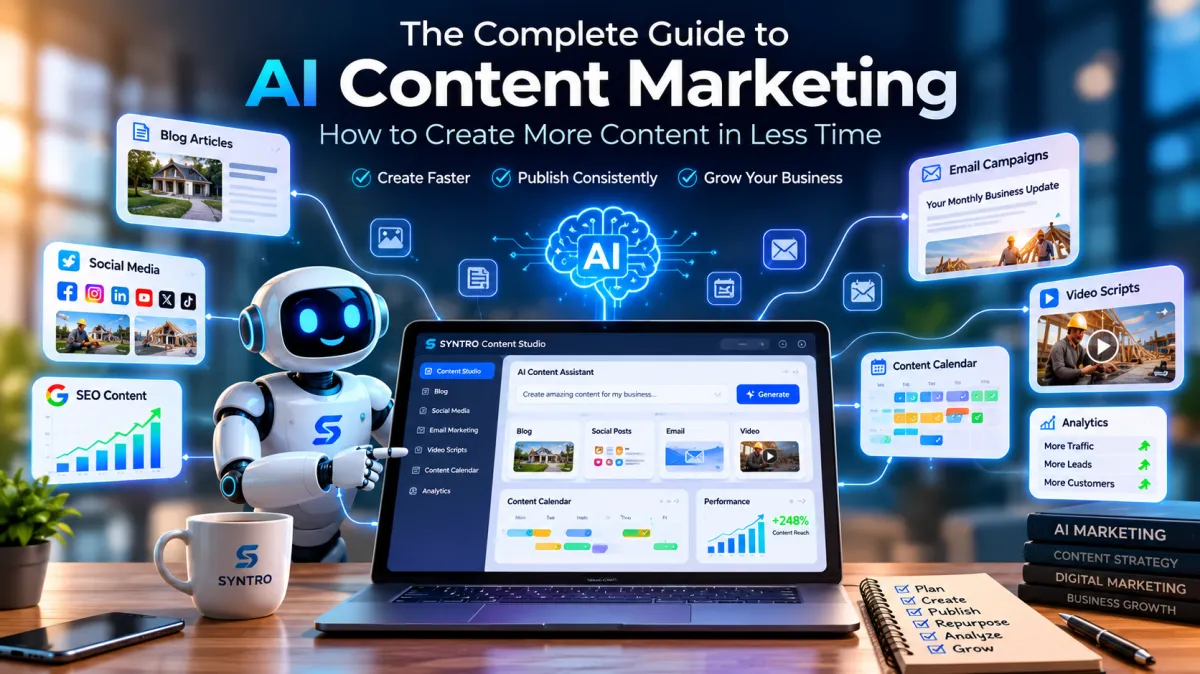
Creating high-quality content consistently can be challenging, especially for busy business owners and small marketing teams. AI-powered platforms like SYNTRO Content Studio are designed to simplify the entire content creation process by bringing planning, writing, campaign management, and AI assistance together in one workspace.
Instead of juggling multiple tools, businesses can organize content calendars, generate blog articles, create social media campaigns, write email marketing sequences, develop video scripts, and manage marketing projects from a single platform. AI assists throughout the process by helping brainstorm ideas, generate first drafts, maintain a consistent brand voice, and repurpose existing content into multiple formats.
Whether you're creating your first blog post or managing an ongoing marketing strategy, having a centralized content system improves consistency, saves valuable time, and allows your team to focus more on strategy and customer engagement rather than repetitive marketing tasks.
Learn more about SYNTRO Content Studio and discover how AI can help you create smarter marketing campaigns, publish content more consistently, and grow your business.
👉 Explore SYNTRO Content Studio
Frequently Asked Questions
What is AI content marketing?
AI content marketing uses artificial intelligence to assist with planning, creating, optimizing, publishing, and managing marketing content across multiple channels.
Can AI replace content writers?
No. AI works best as a creative assistant that accelerates research, drafting, and organization while human expertise ensures accuracy, originality, and authenticity.
Does AI-generated content rank in Google?
Search engines evaluate the quality and usefulness of content rather than how it was created. Helpful, accurate, well-structured articles that satisfy user intent have the best opportunity to perform well.
How often should businesses publish content?
Consistency is more important than frequency. Publishing one high-quality article every week or every two weeks is generally more effective than producing large amounts of low-quality content.
Which businesses benefit most from AI content marketing?
Nearly every industry can benefit, including contractors, landscapers, manufacturers, retailers, consultants, accountants, law firms, healthcare providers, home service companies, and technology businesses.
Final Thoughts
Content marketing has become one of the most valuable long-term investments a business can make. Every article, email, video, and social media post contributes to your company's reputation, search engine visibility, and customer relationships.
Artificial Intelligence doesn't eliminate the need for creativity or expertise. Instead, it removes many of the repetitive tasks that slow marketing teams down. Businesses can spend less time struggling with blank pages and more time sharing valuable knowledge, helping customers, and building lasting relationships.
The businesses that succeed over the coming years won't necessarily publish the most content—they'll publish the most helpful content, consistently. By combining AI with a clear strategy, strong brand voice, and commitment to educating customers, organizations of every size can compete more effectively than ever before.
Start small. Create one valuable article. Repurpose it into multiple formats. Measure the results. Improve your process. Then repeat. Over time, you'll build a marketing engine that continues generating trust, traffic, and qualified leads long after each piece of content is published.
Ready to Transform Your Content Marketing?
The SYNTRO Content Studio platform helps businesses plan campaigns, create blogs, generate social media content, build email marketing sequences, produce video scripts, manage content calendars, and organize every stage of the content creation process with AI.
Whether you're creating your first blog article or managing a full-scale marketing strategy, the right content system can help you produce more valuable content, reach more customers, and grow your business with confidence.
Explore SYNTRO Content Studio and discover how AI can help you build a smarter, faster, and more effective content marketing system.


